
|
You entered: composite image
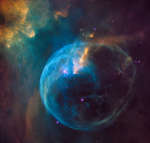 NGC 7635: The Bubble Nebula
22.04.2016
Blown by the wind from a massive star, this interstellar apparition has a surprisingly familiar shape. Cataloged as NGC 7635, it is also known simply as The Bubble Nebula. Although it looks delicate, the 7 light-year diameter bubble offers evidence of violent processes at work.
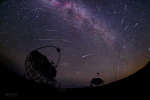 Gamma rays and Comet Dust
20.08.2016
Gamma-rays and dust from periodic Comet Swift-Tuttle plowed through planet Earth's atmosphere on the night of August 11/12. Impacting at about 60 kilometers per second the grains of comet dust produced this year's remarkably active Perseid meteor shower.
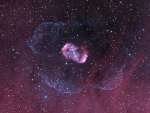 A Halo for NGC 6164
7.05.2009
Beautiful emission nebula NGC 6164 was created by a rare, hot, luminous O-type star, some 40 times as massive as the Sun. Seen at the center of the cosmic cloud, the star is a mere 3 to 4 million years old.
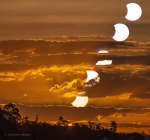 Brisbane Sunset Moonset
1.05.2014
In skies over Brisbane at the southeastern corner of Queensland, Australia, Planet Earth, the Sun and New Moon set together on April 29. There the celestial line-up, the first solar eclipse of 2014, was seen as a partial solar eclipse.
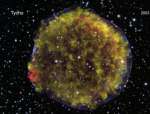 Tychos Supernova Remnant Expands
1.06.2016
What star created this huge expanding puffball? Featured here is the first expansion movie ever created for Tycho's supernova remnant, the result of a stellar explosion first recorded over 400 years ago by the famous astronomer Tycho Brahe.
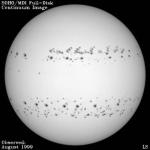 Follow The Spots
21.10.1999
The Sun rotates on its axis about once every 27 days. How can you tell? Just follow the sunspots. This composite picture was constructed from solar images recorded daily by the MDI instrument on board the space-based SOlar and Heliospheric Observatory (SOHO).
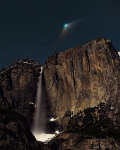 APOD: 2023 February 21 Б Comet ZTF over Yosemite Falls
21.02.2023
They are both falling. The water in Yosemite Falls, California, USA, is falling toward the Earth. Comet ZTF is falling toward the Sun. This double cosmic cascade was captured late last month as fading Comet C/2022 E3 (ZTF) had just passed its closest to planet Earth. The orange star just over the falls is Kochab.
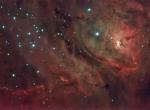 M8: The Lagoon Nebula
10.02.2006
This beautiful cosmic cloud is a popular stop on telescopic tours of the constellation Sagittarius. Eighteenth century cosmic tourist Charles Messier cataloged the bright nebula as M8, while modern day astronomers recognize the Lagoon...
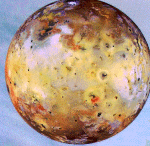 Io Full Face
29.10.1996
Io is a colorful place. The closest large moon of Jupiter, Io is the most volcanic moon in the Solar System with its surface being completely buried in volcanic lava every few thousand years.
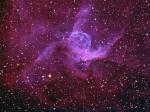 Thor s Helmet in H Alpha
2.02.2006
Near picture center, the helmet-shaped structure with wing-like appendages is popularly called Thor's Helmet. Cataloged as NGC 2359, the striking nebula is located about 15,000 light-years away in the constellation Canis Major.
|
January February March April May June July August |
||||||||||||||||||||||||||||||||||||||||||||||||||||||||