
|
You entered: massive stars
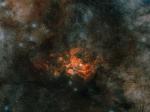 Star Forming Region NGC 6357
20.12.2006
For reasons unknown, NGC 6357 is forming some of the most massive stars ever discovered. Near the more obvious Cat's Paw nebula, NGC 6357 houses the open star cluster Pismis 24, home to these tremendously bright and blue stars.
 The Tarantula Zone
26.04.2008
The Tarantula Nebula is more than 1,000 light-years in diameter -- a giant star forming region within our neighboring galaxy the Large Magellanic Cloud (LMC). That cosmic arachnid lies at the upper left of this expansive mosiac covering a part of the LMC over 6,000 light-years across.
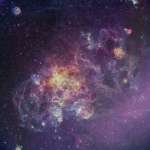 The Tarantula Zone
16.09.2009
The Tarantula Nebula is more than 1,000 light-years in diameter -- a giant star forming region within our neighboring galaxy the Large Magellanic Cloud (LMC). That cosmic arachnid lies left of center in this in this colorful telescopic image taken through narrow-band filters. It covers a part of the LMC over 2,000 light-years across.
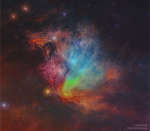 Seven Dusty Sisters
28.05.2018
Is this really the famous Pleaides star cluster? Known for its iconic blue stars, the Pleaides is shown here in infrared light where the surrounding dust outshines the stars. Here three infrared colors have been mapped into visual colors (R=24, G=12, B=4.6 microns).
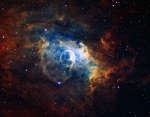 NGC 7635: The Bubble Nebula
11.10.2011
It's the bubble versus the cloud. NGC 7635, the Bubble Nebula, is being pushed out by the stellar wind of massive central star BD+602522. Next door, though, lives a giant molecular cloud, visible to the right. At this place in space, an irresistible force meets an immovable object in an interesting way.
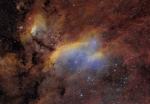 IC 4628: The Prawn Nebula
20.10.2006
South of Antares, in the tail of the nebula-rich constellation Scorpius, lies emission nebula IC 4628. Nearby hot, massive stars, millions of years young, radiate the nebula with invisible ultraviolet light, stripping electrons from atoms. The electrons eventually recombine with the atoms to produce the visible nebular glow.
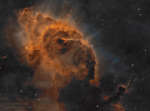 HH 666: Carina Dust Pillar with Jet
6.12.2017
To some, it may look like a beehive harboring an evil bee. In reality, the featured Hubble image captures a cosmic pillar of dust, two-light years long, inside of which is Herbig-Haro 666 -- a young star emitting powerful jets.
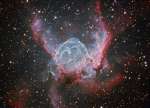 Thor s Helmet
5.06.2010
This helmet-shaped cosmic cloud with wing-like appendages is popularly called Thor's Helmet. Heroically sized even for a Norse god, Thor's Helmet is about 30 light-years across. In fact, the helmet is actually...
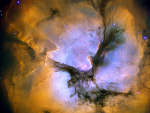 In the Center of the Trifid Nebula
30.06.2008
Clouds of glowing gas mingle with lanes of dark dust in the Trifid Nebula, a star forming region toward the constellation of Sagittarius. In the center, the three huge dark dust lanes that give the Trifid its name all come together.
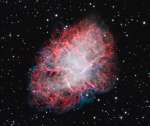 M1: The Incredible Expanding Crab
5.09.2013
The Crab Nebula is cataloged as M1, the first on Charles Messier's famous list of things which are not comets. In fact, the Crab is now known to be a supernova remnant, an expanding cloud of debris from the explosion of a massive star.
|
January February March April |
|||||||||||||||||||||||||||||||||||||||||||||||||