
|
You entered: image
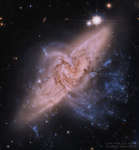 NGC 3314: When Galaxies Overlap
17.11.2021
Why doesn't the nearby galaxy create a gravitational lensing effect on the background galaxy? It does, but since both galaxies are so nearby, the angular shift is much smaller than the angular sizes of the galaxies themselves.
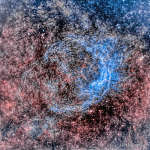 The Asymmetric Nebula Surrounding Wolf Rayet Star 18
9.11.2022
Why does the nebula around the star WR-18 shine brighter on one side? Also known as NGC 3199, this active star and its surrounding nebula lie about 12,000 light-years away toward the nautical southern constellation of Carina.
 APOD: 2023 April 11 Б North Star: Polaris and Surrounding Dust
11.04.2023
Why is Polaris called the North Star? First, Polaris is the nearest bright star toward the north spin axis of the Earth. Therefore, as the Earth turns, stars appear to revolve around Polaris, but Polaris itself always stays in the same northerly direction -- making it the North Star.
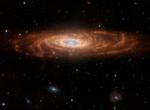 NGC 7331: A Galaxy So Inclined
1.07.2004
If our own Milky Way galaxy were 50 million light-years away with its disk inclined slightly to our line of sight, it would look a lot like large spiral galaxy NGC 7331. In fact...
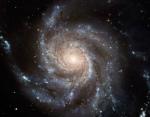 Messier 101
2.03.2006
Big, beautiful spiral galaxy M101 is one of the last entries in Charles Messier's famous catalog, but definitely not one of the least. About 170,000 light-years across, this galaxy is enormous, almost twice the size of our own Milky Way galaxy.
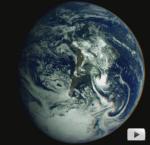 Rotating Earth from Galileo
14.05.2007
When passing Earth on your way to Jupiter, what should you look for? That question arose for the robotic Galileo spacecraft that soundlessly coasted past the Solar System's most photographed orb almost two decades ago.
 Cat s Eye Hubble Remix
22.03.2008
Staring across interstellar space, the alluring Cat's Eye Nebula lies three thousand light-years from Earth. One of the most famous planetary nebulae in the sky, the Cat's Eye (NGC 6543) is over half a light-year across and represents a final, brief yet glorious phase in the life of a sun-like star.
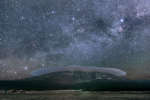 A Protected Night Sky Over Flagstaff
16.04.2008
This sky is protected. Yesterday marked the 50 year anniversary of the first lighting ordinance ever enacted, which restricted searchlight advertisements from sweeping the night skies above Flagstaff, Arizona, USA. Flagstaff now enjoys...
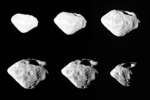 Rosetta Spacecraft Passes Asteroid Steins
8.09.2008
What's that diamond in the sky? Cruising though space, sometimes you'll come across an unusual object. Such was the case on Friday for ESA's Rosetta spacecraft on it's way to comet Churyumov-Gerasimenko in 2014.
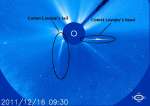 Comet Lovejoy: Sungrazing Survivor
17.12.2011
Like most other sungrazing comets, Comet Lovejoy (C/2011 W3) was not expected to survive its close encounter with the Sun. But it did. This image from a coronograph onboard the sun-staring SOHO spacecraft identifies the still inbound remnants of the tail, with the brilliant head or coma emerging from the solar glare on December 16.
|
January February March April May June July August September |
|||||||||||||||||||||||||||||||||||||||||||||||||