
|
You entered: Earth's atmosphere
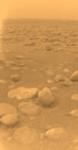 Titan Landscape
17.01.2005
This color view from Titan gazes across a suddenly familiar but distant landscape on Saturn's largest moon. The scene was recorded by ESA's Huygens probe after a 2 1/2 hour descent through a thick atmosphere of nitrogen laced with methane.
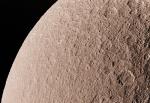 Rhea: Saturn's Second Largest Moon
8.06.2003
Rhea is the second largest moon of Saturn, behind Titan, and the largest without an atmosphere. It is composed mostly of water ice, but has a small rocky core. Rhea's rotation and orbit are locked together (just like Earth's Moon) so that one side always faces Saturn.
 Anticrepuscular Rays at the Planet Festival
19.07.2024
For some, these subtle bands of light and shadow stretched across the sky as the Sun set on July 11. Known as anticrepuscular rays, the bands are formed as a large cloud bank near the western horizon cast long shadows through the atmosphere at sunset.
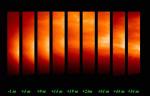 A Martian Sunset
1.08.1997
You've had a hard day rolling past Martian rocks, so now just relax your APXS and enjoy the Martian sunset. The above pictures taken by Mars Pathfinder highlight how clouds vary during the end of a Martian day.
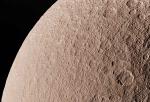 Rhea: Saturns Second Largest Moon
5.12.1999
Rhea is the second largest moon of Saturn, behind Titan, and the largest without an atmosphere. It is composed mostly of water ice, but has a small rocky core. Rhea's rotation and orbit are locked together (just like Earth's Moon) so that one side always faces Saturn.
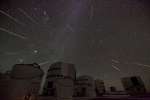 When Gemini Sends Stars to Paranal
15.12.2012
From a radiant point in the constellation of the Twins, the annual Geminid meteor shower rained down on planet Earth this week. Recorded near the shower's peak in the early hours of December...
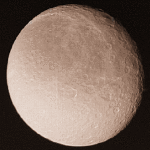 Rhea: Saturn's Second Largest Moon
14.10.1995
Rhea is the second largest moon of Saturn, behind Titan, and the largest without an atmosphere. It is composed mostly of water ice, but has a small rocky core. Rhea's rotation and orbit are locked together (just like Earth's Moon) so that one side always faces Saturn.
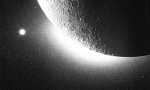 Sunshine, Earthshine at the Lunar Limb
30.05.1996
This dramatic image of the Moon's edge against a background of distant stars is from a perspective impossible for groundbased telescopes. It was taken by a star tracker camera onboard the Clementine spacecraft.
 Perseids of Summer
10.08.2001
Like falling stardust, cast off bits of comet Swift-Tuttle hurtle through the upper atmosphere about this time each year as planet Earth passes near the comet's orbital path. For the northern hemisphere, this...
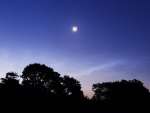 Night Shinings
2.07.2008
In the early morning hours of June 30th, ghostly clouds hovered in the east in this view of near dawn skies over western France. The noctilucent or night-shining clouds lie near the edge of space, reflecting sunlight from about 80 kilometers above Earth's surface.
|
January February March April May June July August September October |
|||||||||||||||||||||||||||||||||||||||||||||||||