
|
You entered: Earth orbit
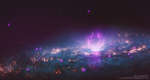 X Ray Superbubbles in Galaxy NGC 3079
5.03.2019
What created these huge galactic superbubbles? Two of these unusual bubbles, each spanning thousands of light-years, were recently discovered near the center of spiral galaxy NGC 3079. The superbubbles, shown in purple on the image right, are so hot they emit X-rays detected by NASA's Earth-orbiting Chandra X-Ray Observatory.
 Cold Comet Halley
3.10.2003
While this may not be the most esthetic image of Comet Halley that you have ever seen, it is likely the most unique. The tiny cluster of pixels circled is the famous comet along...
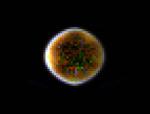 Gamma Ray Earth
3.06.2006
The pixelated planet above is actually our own planet Earth seen in gamma rays - the most energetic form of light. In fact, the gamma rays used to construct this view pack over 35 million electron volts (MeV) compared to a mere two electron volts (eV) for a typical visible light photon.
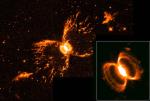 Symbiotic Star Bubbles
31.08.1999
The two stars at the center of this nebula are very different. One is a white dwarf star with a mass similar to our Sun but with a radius as small as our Earth.
 APOD: 2023 October 17 Б PDS 70: Disk, Planets, and Moons
17.10.2023
It's not the big ring that's attracting the most attention. Although the big planet-forming ring around the star PDS 70 is clearly imaged and itself quite interesting. It's also not the planet on the right, just inside the big disk, thatБs being talked about the most.
 APOD: 2024 May 28 Б Solar X Flare as Famous Active Region Returns
28.05.2024
It's back. The famous active region on the Sun that created auroras visible around the Earth earlier this month has survived its rotation around the far side of the Sun -- and returned. Yesterday...
 Eclipsed Moon in Infrared
8.11.2003
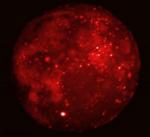
The total lunar eclipse of September 1996 disappointed many observers in North America who were cursed with cloudy skies. However, the Midcourse Space Experiment (MSX) satellite had a spectacular view from Earth orbit and SPIRIT III, an on board infrared telescope, was used to repeatedly image the moon during the eclipse.
 Light Can Twist as Well as Spin
19.11.2003
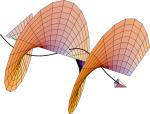
Light is more complicated than we thought. When astronomers measure light, they are usually concerned with its direction, energy, and spin polarization (sometimes). Recently, however, it has been more broadly realized that photons...
 Three Worlds for TRAPPIST 1
7.05.2016
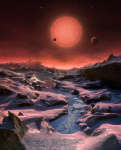
Three new found worlds orbit the ultracool dwarf star TRAPPIST-1, a mere 40 light-years away. Their transits were first detected by the Belgian robotic TRAnsiting Planets and Planetesimals Small Telescope, TRAPPIST, at ESO's La Silla Observatory in Chile. The newly discovered exoplanets are all similar in size to Earth.
 Perigee Moon, Apogee Moon
22.12.1999
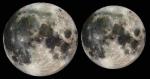
Tonight, those blessed with clear skies can enjoy a glorious full moon, the last full moon of the "Y1.9K"s. In fact, tonight's moon will be a full-perigee-solstice moon, reaching its full phase and perigee (the closest point in its orbit) on the solstice, the first day of northern hemisphere winter.
|
January February March April May June July August September October |
|||||||||||||||||||||||||||||||||||||||||||||||||