
|
You entered: dark
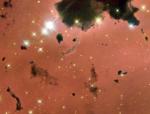 Thackerays Globules
16.08.2003
Rich star fields and glowing hydrogen gas silhouette dense, opaque clouds of interstellar gas and dust in this Hubble Space Telescope close-up of IC 2944, a bright star forming region in Centaurus, 5,900 light-years away. The largest of these dark globules, first spotted by South African astronomer A. D.
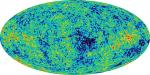 WMAP Resolves the Universe
11.07.2004
Analyses of a new high-resolution map of microwave light emitted only 380,000 years after the Big Bang appear to define our universe more precisely than ever before. The eagerly awaited results announced last year from the orbiting Wilkinson Microwave Anisotropy Probe resolve several long-standing disagreements in cosmology rooted in less precise data.
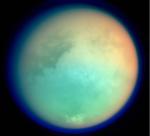 Tantalizing Titan
28.10.2004
Normally hidden by a thick, hazy atmosphere, tantalizing features on Titan's surface appear in this false-color view. The image was recorded as the Cassini spacecraft approached its first close flyby of Saturn's smog-shrouded moon on October 26.
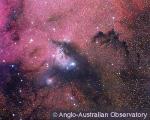 Reflections on NGC 6188
25.08.1999
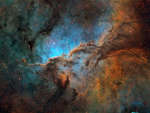
NGC 6188 is an interstellar carnival of young blue stars, hot red gas, and cool dark dust. Located 4000 light years away in the disk of our Galaxy, NGC 6188 is home to the Ara OB1 association, a group of bright young stars whose nucleus forms the open cluster NGC 6193.
 Shaping NGC 6188
16.07.2010
Dark shapes with bright edges winging their way through dusty NGC 6188 are tens of light-years long. The emission nebula is found near the edge of an otherwise dark large molecular cloud in the southern constellation Ara, about 4,000 light-years away.
 A Partially Eclipsed Setting Sun
30.04.2014
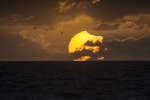
If you look closely, you will see something quite unusual about this setting Sun. There are birds flying to the Sun's left, but that's not so unusual. A dark sea covers the Sun's bottom, and dark clouds cover parts of the middle, but they are also not very unusual.
 M45: The Pleiades Star Cluster
1.09.2019
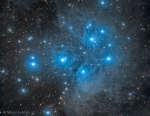
Have you ever seen the Pleiades star cluster? Even if you have, you probably have never seen it as dusty as this. Perhaps the most famous star cluster on the sky, the bright stars of the Pleiades can be seen without binoculars from even the depths of a light-polluted city.
 A Distorted Sunrise Eclipse
6.06.2021
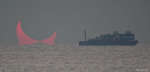
Yes, but have you ever seen a sunrise like this? Here, after initial cloudiness, the Sun appeared to rise in two pieces and during partial eclipse, causing the photographer to describe it as the most stunning sunrise of his life.
 A Lion in Orion
7.03.2022
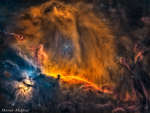
Yes, but can you see the lion? A deep exposure shows the famous dark indentation that looks like a horse's head, visible just left and below center, and known unsurprisingly as the Horsehead Nebula. The Horsehead Nebula (Barnard 33) is part of a vast complex of dark absorbing dust and bright glowing gas.
 APOD: 2026 September 11 Б M83: The Southern Pinwheel
11.09.2026
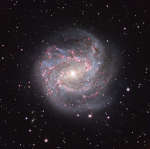
Beautiful and bright spiral galaxy M83 lies some twelve million light-years away, near the southeastern tip of the very long constellation Hydra. Prominent spiral arms traced by dark dust lanes and blue star clusters lend this galaxy its popular name, the Southern Pinwheel.
|
January February March April May June July August September |
|||||||||||||||||||||||||||||||||||||||||||||||||