
|
You entered: nearby stars
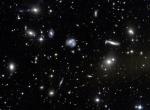 Hercules Galaxies
27.08.1998
These are galaxies of the Hercules Cluster, an archipelago of "island universes" a mere 650 million light-years distant. This cluster is loaded with gas and dust rich, star forming, spiral galaxies but has relatively few elliptical galaxies, which lack gas and dust and the associated newborn stars.
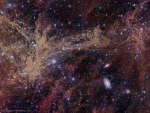 The M81 Galaxy Group through the Integrated Flux Nebula
27.06.2017
Distant galaxies and nearby nebulas highlight this deep image of the M81 Group of galaxies. First and foremost in this 80-exposure mosaic is the grand design spiral galaxy M81, the largest galaxy in the image, visible on the lower right.
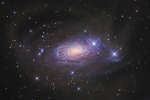 Star Streams and the Sunflower Galaxy
11.09.2010
A bright spiral galaxy of the northern sky, Messier 63 is about 25 million light-years distant in the loyal constellation Canes Venatici. Also cataloged as NGC 5055, the majestic island universe is nearly 100,000 light-years across, about the size of our own Milky Way.
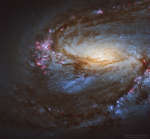 Spiral Galaxy M66 from Hubble
24.02.2021
ItБs always nice to get a new view of an old friend. This stunning Hubble Space Telescope image of nearby spiral galaxy M66 is just that. A spiral galaxy with a small central bar, M66 is a member of the Leo Galaxy Triplet, a group of three galaxies about 30 million light years from us.
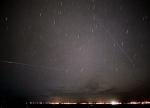 Mir Flares Farewell
23.03.2001
Streaking low across the western horizon after sunset, the Russian Mir space station makes a final pass through the evening sky above the coastal city of Salvador, Brazil. In this 5 minute 20 second time exposure made with ASA 800 film and a wide-angle lens on March 19, setting stars leave short, almost vertical trails.
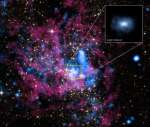 The Quiet Sagittarius A
6.09.2013
Hot gas is hard to swallow. At least that seems to be true for the supermassive black hole at the center of our Milky Way Galaxy. Known as source Sagittarius A*, the Milky Way's black hole is centered in this infrared (red and yellow hues) and X-ray (blue) composite.
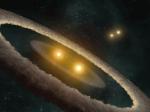 The Four Suns of HD 98800
30.07.2007
How would it look to have four suns in the sky? Planets of the HD 98800 system, if they exist, would experience such a view. HD 98800 is a multiple star system about 150 light years from Earth -- right in our section of the Milky Way Galaxy.
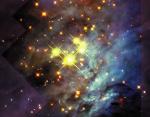 The Brown Dwarfs of Orions Trapezium
30.08.2000
The bright stars above are well known as heart of the Trapezium, an open cluster of stars in the center of the Orion Nebula. The many dim objects, however, are not well known, and have come to attention only on recent images in infrared light.
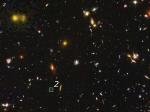 Building Galaxies in the Early Universe
10.09.2007
What was the very early universe like? To help find out, astronomers pointed the Hubble Space Telescope between bright nearby objects to create one of the deepest images ever -- the Hubble Ultra Deep Field (HUDF). The resulting HUDF is like a jewel box of strange and distant galaxies.
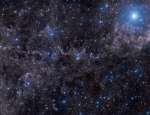 Stars in a Dusty Sky
28.09.2012
Bright star Markab anchors this dusty skyscape. At the top right corner of the frame, Markab itself marks a corner of an asterism known as the Great Square, found within the boundaries of the constellation Pegasus, the flying horse.
|
January February March April May June July August |
||||||||||||||||||||||||||||||||||||||||||||||||||||||||