
|
You entered: image
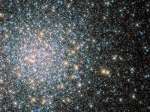 Hubble s Messier 5
25.04.2014
"Beautiful Nebula discovered between the Balance [Libra] & the Serpent [Serpens] ..." begins the description of the 5th entry in 18th century astronomer Charles Messier's famous catalog of nebulae and star clusters. Though it appeared...
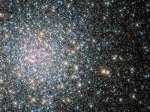 Hubble s Messier 5
20.06.2015
"Beautiful Nebula discovered between the Balance [Libra] & the Serpent [Serpens] ..." begins the description of the 5th entry in 18th century astronomer Charles Messier's famous catalog of nebulae and star clusters. Though it appeared...
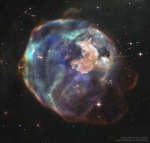 N63A: Supernova Remnant in Visible and X-ray
11.12.2019
What has this supernova left behind? As little as 2,000 years ago, light from a massive stellar explosion in the Large Magellanic Cloud (LMC) first reached planet Earth. The LMC is a close...
 The Hydrogen Clouds of M33
30.09.2021
Gorgeous spiral galaxy M33 seems to have more than its fair share of glowing hydrogen gas. A prominent member of the local group of galaxies, M33 is also known as the Triangulum Galaxy and lies a mere 3 million light-years away.
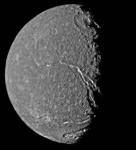 Titania's Trenches
30.09.2000
British astronomer Sir William Herschel discovered Titania and Oberon in January of 1787. He wasn't reading Shakespeare's A Midsummer Night's Dream though, he was making the first telescopic observations of moons of the planet Uranus (a planet which he himself discovered in 1781).
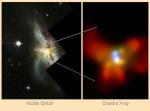 The Supermassive Black Holes of NGC 6240
28.11.2002
The Hubble optical image on the left shows NGC 6240 in the throes of a titanic galaxy - galaxy collision 400 million light-years away. As the cosmic catastrophe plays out, the merging galaxies spew forth distorted tidal tails of stars, gas, and dust and undergo frantic bursts of star formation.
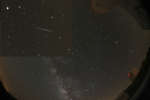 A Twisted Meteor Trail Over Tenerife
2.06.2010
Did this meteor take a twisting path? No one is sure. Considered opinions are solicited. Meteors, usually sand sized grains that originate in comets, will typically disintegrate as they enter the Earth's atmosphere. A fast moving meteor ionizes molecules in the Earth's atmosphere that subsequently glow when they reacquire electrons.
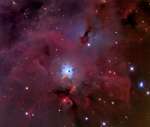 NGC 1999: South of Orion
24.02.2011
South of the large star-forming region known as the Orion Nebula, lies bright blue reflection nebula NGC 1999. Also at the edge of the Orion molecular cloud complex some 1,500 light-years distant, NGC 1999's illumination is provided by the embedded variable star V380 Orionis.
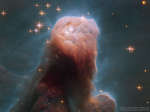 The Cone Nebula from Hubble
15.03.2017
Stars are forming in the gigantic dust pillar called the Cone Nebula. Cones, pillars, and majestic flowing shapes abound in stellar nurseries where natal clouds of gas and dust are buffeted by energetic winds from newborn stars. The Cone Nebula, a well-known example, lies within the bright galactic star-forming region NGC 2264.
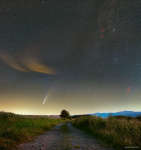 Comet NEOWISE and Nebulae
20.07.2020
Would you brave wild animals to photograph this sky? One astrophotographer did -- and we all get to reap the rewards. First, thousands of stars were visible with many of the brightest impressively blue. Next, several red-glowing nebulae were discernible, including the California Nebula on the far right, and, above it, the Heart and Soul nebulae.
|
January February March April May June July August September |
|||||||||||||||||||||||||||||||||||||||||||||||||