
|
You entered: Earth's moon
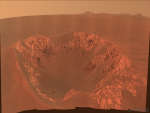 Intrepid Crater on Mars from Opportunity
4.04.2018
The robotic rover Opportunity sometimes passes small craters on Mars. Pictured here in 2010 is Intrepid Crater, a 20-meter across impact basin slightly larger than Nereus Crater that Opportunity had chanced across previously. The featured image is in approximately true color but horizontally compressed to accommodate a wide angle panorama.
 APOD: 2025 July 5 Б Ou4: The Giant Squid Nebula
5.07.2025
Difficult to capture, this mysterious, squid-shaped interstellar cloud spans nearly three full moons in planet Earth's sky. Discovered in 2011 by French astro-imager Nicolas Outters, the Squid Nebula's bipolar shape is distinguished here by the telltale blue emission from doubly ionized oxygen atoms.
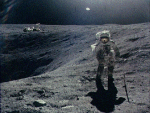 Apollo 16: Exploring Plum Crater
7.06.1996
Apollo 16 spent three days on Earth's Moon in April 1972. The fifth lunar landing mission out of six, Apollo 16 was famous for deploying and using an ultraviolet telescope as the first lunar observatory, and for collecting rocks and data on the mysterious lunar highlands. In the above picture, astronaut John W.
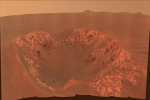 Intrepid Crater on Mars
8.12.2010
The robotic rover Opportunity has chanced across another small crater on Mars. Pictured above is Intrepid Crater, a 20-meter across impact basin slightly larger than Nereus Crater that Opportunity chanced across last year. The above image is in approximately true color but horizontally compressed to accommodate a wide angle panorama.
 Iridescent by Moonlight
4.12.2021
In this snapshot from November 18, the Full Moon was not far from Earth's shadow. In skies over Sicily the brightest lunar phase was eclipsed by passing clouds though. The full moonlight was dimmed and momentarily diffracted by small but similar sized water droplets near the edges of the high thin clouds.
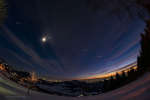 Planetary Alignment over Italy
19.12.2021
It is not a coincidence that planets line up. That's because all of the planets orbit the Sun in (nearly) a single sheet called the plane of the ecliptic. When viewed from inside that plane -- as Earth dwellers are likely to do -- the planets all appear confined to a single band.
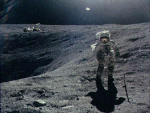 Apollo 16: Exploring Plum Crater
20.12.1997
Apollo 16 spent three days on Earth's Moon in April 1972. The fifth lunar landing mission out of six, Apollo 16 was famous for deploying and using an ultraviolet telescope as the first lunar observatory, and for collecting rocks and data on the mysterious lunar highlands. In the above picture, astronaut John W.
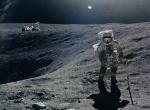 Apollo 16: Exploring Plum Crater
19.03.2000
Apollo 16 spent three days on Earth's Moon in April 1972. The fifth lunar landing mission out of six, Apollo 16 was famous for deploying and using an ultraviolet telescope as the first lunar observatory, and for collecting rocks and data on the mysterious lunar highlands. In the above picture, astronaut John W.
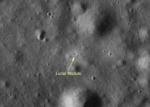 Lunar Module at Taurus Littrow
28.06.2002
Can the Hubble Space Telescope take a picture that shows the Apollo lunar modules on the Moon? With its 2.4 meter diameter mirror, the smallest object that the Hubble can resolve at the Moon's distance of around 400,000 kilometers is about 80 meters across.
 The Sky in Motion
31.12.2008
Still need to come up with a good new year's resolution? Consider one appropriate for 2009, the International Year of Astronomy; just look up -- experience, learn, and enjoy the changing sky. This 4-minute, time-lapse video is composed from a series of 7,000 images highlighting much of what you could see.
|
January February March April May June July August September |
|||||||||||||||||||||||||||||||||||||||||||||||||