
|
You entered: Moon
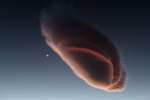 Lenticular Cloud, Moon, Mars, Venus
1.03.2015
It is not every day that such an interesting cloud photobombs your image. The original plan was to photograph a rare angular conjunction of Mars and Venus that occurred a week and a half ago, with the added bonus of a crescent Moon and the International Space Station (ISS) both passing nearby.
 Mercury and Crescent Moon Set
15.04.2016
Innermost planet Mercury and a thin crescent Moon are never found far from the Sun in planet Earth's skies. Taken near dusk on April 8, this colorful evening skyscape shows them both setting toward the western horizon just after the Sun.
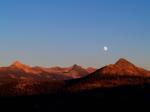 Autumn Moon Encore
15.12.2005
Near its northernmost declination, tonight's Full Moon will be a special one, arcing high in northern hemisphere skies. But a Full Moon won't occur on this calendar date for another 19 years, a period known as the lunar Metonic cycle.
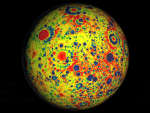 GRAIL Maps the Moons Gravity
19.03.2013
How did the Moon form? To help find out, NASA launched the twin Gravity Recovery and Interior Laboratory (GRAIL) satellites in 2011 to orbit and map the Moon's surface gravity in unprecedented detail.
 APOD: 2024 July 24 Б Exaggerated Moon
24.07.2024
Our Moon doesn't really have craters this big. Earth's Moon, Luna, also doesn't naturally show this spikey texture, and its colors are more subtle. But this digital creation is based on reality.
 A Wavemaker Moon in Saturns Rings
23.05.2005
What causes small waves in Saturn's rings? Observations of rings bordering the Keeler gap in Saturn's rings showed unusual waves. Such waves were first noticed last July and are shown above in clear detail.
 Moon Pi and Mountain Shadow
14.03.2024
What phase of the Moon is 3.14 radians from the Sun? The Full Moon, of course. Even though the Moon might look full for several days, the Moon is truly at its full phase when it is Pi radians (aka 180 degrees) from the Sun in ecliptic longitude.
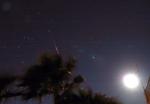 Leonids vs The Moon
20.11.2002
Beautiful and bright, the 2002 Leonid meteors battled against glaring moonlight. This winning example, from Tuesday morning skies above Laughlin, Nevada, USA, finds an undaunted Leonid streaking between the familiar constellation of Orion (left) and an overexposed full Moon.
 Phobos: Doomed Moon of Mars
18.08.2001
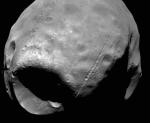
Mars, the red planet named for the Roman god of war, has two tiny moons, Phobos and Deimos, whose names are derived from the Greek for Fear and Panic. These Martian moons may well...
 Possible Pluto Moons
3.11.2005
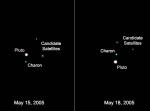
In 1930, tiny, icy world Pluto was discovered orbiting in the distant solar system. In 1978, its relatively large companion Charon was detected by ground-based observations. This year, the Hubble Space Telescope may well have detected two further members of the Pluto system.
|
January February March April May June July August September October |
|||||||||||||||||||||||||||||||||||||||||||||||||