
|
You entered: Ring Nebula
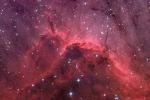 IC 5067: Emission Nebula Close up
27.12.2006
This amazing skyscape lies along a bright ridge of emission in IC 5067, also known as The Pelican Nebula. Appropriately, the Pelican Nebula itself is part of a much larger, complex star-forming region about 2,000 light-years away in the high flying constellation Cygnus, the Swan.
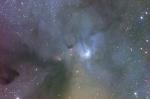 IC 4603: Reflection Nebula in Ophiuchius
21.07.2003
Why does this starfield photograph resemble an impressionistic painting? The effect is created not by digital trickery but by large amounts of interstellar dust. Dust, minute globs rich in carbon and similar in size to cigarette smoke, frequently starts in the outer atmospheres of large, cool, young stars.
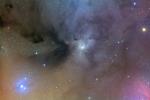 IC 4603: Reflection Nebula in Ophiuchius
4.06.2007
Why does this starfield photograph resemble an impressionistic painting? The effect is created not by digital trickery but by large amounts of interstellar dust. Dust, minute globs rich in carbon and similar in size to cigarette smoke, frequently starts in the outer atmospheres of large, cool, young stars.
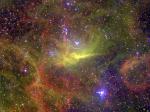 Nebulas Surrounding Wolf Rayet Binary
BAT99 49
Nebulas Surrounding Wolf Rayet Binary
BAT99 49
21.04.2004
How could two young stars power these colorful interstellar gas clouds? Although hidden by thick dust, the stars spew forceful ions and energetic radiation that cause the clouds to fragment and light up.
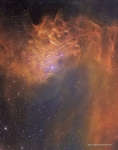 IC 405: The Flaming Star Nebula
7.01.2020
Rippling dust and gas lanes give the Flaming Star Nebula its name. The orange and purple colors of the nebula are present in different regions and are created by different processes. The bright star...
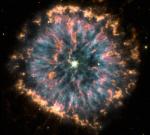 Celebrating Hubble With NGC 6751
7.04.2000
Planetary nebulae do look simple, round, and planet-like in small telescopes. But images from the orbiting Hubble Space Telescope have become well known for showing these fluorescent gas shrouds of dying Sun-like stars to possess a staggering variety of detailed symmetries and shapes.
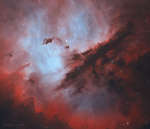 Dust Clouds of the Pacman Nebula
10.08.2022
Stars can create huge and intricate dust sculptures from the dense and dark molecular clouds from which they are born. The tools the stars use to carve their detailed works are high energy light and fast stellar winds.
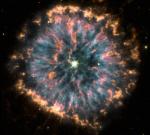 Celebrating Hubble With NGC 6751
16.04.2005
Planetary nebulae can look simple, round, and planet-like in small telescopes. But images from the orbiting Hubble Space Telescope have become well known for showing these fluorescent gas shrouds of dying Sun-like stars to possess a staggering variety of detailed symmetries and shapes.
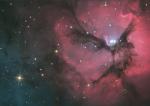 A Beautiful Trifid
1.09.2003
The beautiful Trifid Nebula (aka M20), a photogenic study in cosmic contrasts, lies about 5,000 light-years away toward the nebula rich constellation Sagittarius. A star forming region in the plane of our galaxy...
 APOD: 2024 March 5 Б NGC 2170: Angel Nebula Abstract Art
5.03.2024
Is this a painting or a photograph? In this celestial abstract art composed with a cosmic brush, dusty nebula NGC 2170, also known as the Angel Nebula, shines just above the image center. Reflecting...
|
January February March April May June July August September October |
|||||||||||||||||||||||||||||||||||||||||||||||||