
|
You entered: massive stars
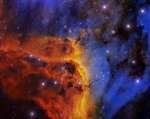 IC 5067 in the Pelican Nebula
26.05.2016
The prominent ridge of emission featured in this sharp, colorful skyscape is cataloged as IC 5067. Part of a larger emission nebula with a distinctive shape, popularly called The Pelican Nebula, the ridge spans about 10 light-years following the curve of the cosmic pelican's head and neck.
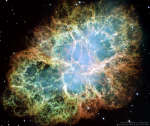 APOD: 2023 January 15 Б M1: The Crab Nebula from Hubble
15.01.2023
This is the mess that is left when a star explodes. The Crab Nebula, the result of a supernova seen in 1054 AD, is filled with mysterious filaments. The filaments are not only tremendously...
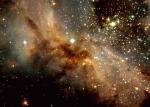 M17: Omega Nebula Star Factory
19.09.2000
In the depths of the dark clouds of dust and molecular gas known as M17, stars continue to form. Visible in the above recently released representative-color photograph of M17 by the New Technology Telescope are clouds so dark that they appear almost empty of near infrared light.
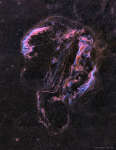 The Ghostly Veil Nebula
31.10.2019
A ghostly visage on a cosmic scale, these remains of shocked, glowing gas haunt planet Earth's sky toward the constellation of Cygnus and form the Veil Nebula. The nebula itself is a large supernova remnant, an expanding cloud born of the death explosion of a massive star.
 M43: Orion Falls
12.12.2018
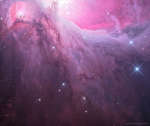
Is there a waterfall in Orion? No, but some of the dust in M43 appears similar to a waterfall on Earth. M43, part of the Orion Molecular Cloud Complex, is the often imaged but rarely mentioned neighbor of the more famous M42.
 APOD: 2025 December 17 Б W5: The Soul Nebula
17.12.2025
Stars are forming in the Soul of the Queen of Aethopia. More specifically, a large star forming region called the Soul Nebula can be found in the direction of the constellation Cassiopeia, whom Greek mythology credits as the vain wife of a King who long ago ruled lands surrounding the upper Nile river.
 The Seagull Nebula
12.01.2011
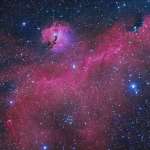
This broad expanse of glowing gas and dust presents a bird-like visage to astronomers from planet Earth, suggesting its popular moniker - The Seagull Nebula. This portrait of the cosmic bird covers a 1.6 degree wide swath across the plane of the Milky Way, near the direction of Sirius, alpha star of the constellation Canis Major.
 The Seagull Nebula
29.08.2015
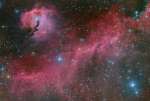
A broad expanse of glowing gas and dust presents a bird-like visage to astronomers from planet Earth, suggesting its popular moniker - The Seagull Nebula. This portrait of the cosmic bird covers a 1.6 degree wide swath across the plane of the Milky Way, near the direction of Sirius, alpha star of the constellation Canis Major.
 Vela Supernova Remnant
6.03.2008
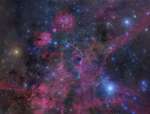
The plane of our Milky Way Galaxy runs through this complex and beautiful skyscape. At the northwestern edge of the constellation Vela (the Sails) the 16 degree wide, 30 frame mosaic is centered on the glowing filaments of the Vela Supernova Remnant, the expanding debris cloud from the death explosion of a massive star.
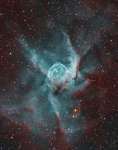 NGC 2359: Thor s Helmet
16.02.2019
NGC 2359 is a helmet-shaped cosmic cloud with wing-like appendages popularly called Thor's Helmet. Heroically sized even for a Norse god, Thor's Helmet is about 30 light-years across. In fact, the helmet...
|
January February March April |
|||||||||||||||||||||||||||||||||||||||||||||||||