
|
You entered: nebula
 APOD: 2024 September 17 Б Melotte 15 in the Heart Nebula
17.09.2024
Cosmic clouds form fantastic shapes in the central regions of emission nebula IC 1805. The clouds are sculpted by stellar winds and radiation from massive hot stars in the nebula's newborn star cluster, Melotte 15.
 APOD: 2026 January 26 Б NGC 55: A Galaxy of Nebulas
26.01.2026
Can you see nebulas in other galaxies? Yes, some nebulas shine brightly enough -- if you know how to look. Clouds of hydrogen and oxygen emit light at very specific colors, and by isolating them, astronomers and astrophotographers can reveal structures that would otherwise be too faint to notice.
 APOD: 2024 December 17 Б Near to the Heart Nebula
17.12.2024
What excites the Heart Nebula? First, the large emission nebula on the upper left, catalogued as IC 1805, looks somewhat like a human heart. The nebula glows brightly in red light emitted by its most prominent element, hydrogen, but this long-exposure image was also blended with light emitted by sulfur (yellow) and oxygen (blue).
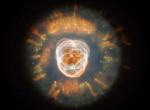 The Eskimo Nebula from the Newly Fixed Hubble
24.01.2000
In 1787, astronomer William Herschel discovered the Eskimo Nebula. From the ground, NGC 2392 resembles a person's head surrounded by a parka hood. In 2000, just after being fixed, the Hubble Space Telescope imaged the Eskimo Nebula. From space, the nebula displays gas clouds so complex they are not fully understood.
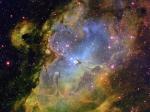 Inside the Eagle Nebula
26.02.2006
From afar, the whole thing looks like an Eagle. A closer look at the Eagle Nebula, however, shows the bright region is actually a window into the center of a larger dark shell of dust. Through this window, a brightly-lit workshop appears where a whole open cluster of stars is being formed.
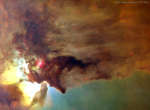 In the Center of the Lagoon Nebula
21.05.2017
The center of the Lagoon Nebula is a whirlwind of spectacular star formation. Visible on the lower left, at least two long funnel-shaped clouds, each roughly half a light-year long, have been formed by extreme stellar winds and intense energetic starlight. The tremendously bright nearby star, Hershel 36, lights the area.
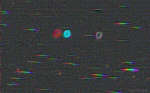 Colors: Ring Nebula versus Stars
21.07.2021
What if you could see, separately, all the colors of the Ring? And of the surrounding stars? There's technology for that. The featured image shows the Ring Nebula (M57) and nearby stars through such technology: in this case, a prism-like diffraction grating.
 APOD: 2026 May 20 Б The Dark Wolf Nebula
20.05.2026
A dark wolf lies in gum. No, this isnБt a riddle! Today's image features the Dark Wolf Nebula (SandqvistБLindroos 17), a spooky dust cloud embedded within the Gum 55 (RCW 113) Nebula in the Scorpius constellation.
 Rigel and the Witch Head Nebula
1.11.2012
Double, double toil and trouble; Fire burn, and cauldron bubble -- maybe Macbeth should have consulted the Witch Head Nebula. The suggestively shaped reflection nebula is associated with the bright star Rigel in the constellation Orion.
 The Variable Nebula NGC 2261
31.01.2025
The interstellar cloud of dust and gas captured in this sharp telescopic snapshot is seen to change its appearance noticeably over periods as short as a few weeks. Discovered over 200 years ago and cataloged as NGC 2261, bright star R Monocerotis lies at the tip of the fan-shaped nebula.
|
January February March April May June July August |
||||||||||||||||||||||||||||||||||||||||||||||||||||||||