
|
You entered: orbit
 Apollo 17: The Crescent Earth
12.05.2023
Our fair planet sports a curved, sunlit crescent against the black backdrop of space in this stunning photograph. From the unfamiliar perspective, the Earth is small and, like a telescopic image of a distant planet, the entire horizon is completely within the field of view.
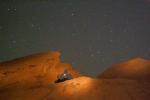 Mars Rising Through Arch Rock
15.07.2003
Mars is heading for its closest encounter with Earth in over 50,000 years. Although Mars and Earth continue in their normal orbits around the Sun, about every two years Earth and Mars are on the same part of their orbit as seen from the Sun.
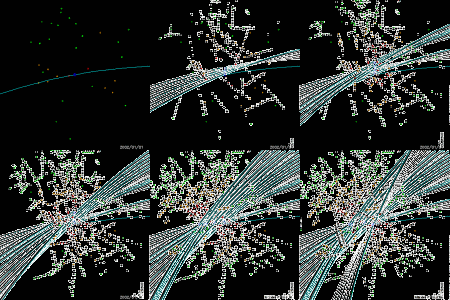 Animation of Asteroids Passing Near Earth
28.03.2006
How often does an asteroid whiz by the Earth? The above time-lapse animation follows the orbit of the Earth around the Sun for two months in 2002 as numerous asteroids, also known as minor planets, approach and pass by. Some asteroids appear out of nowhere as they are plotted only when they were discovered.
 A Hole in Mars
18.07.2012
What created this unusual hole in Mars? The hole was discovered by chance on images of the dusty slopes of Mars' Pavonis Mons volcano taken by the HiRISE instrument aboard the robotic Mars Reconnaissance Orbiter currently circling Mars. The hole appears to be an opening to an underground cavern, partly illuminated on the image right.
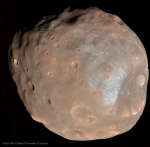 Phobos: Doomed Moon of Mars
21.11.2015
This moon is doomed. Mars, the red planet named for the Roman god of war, has two tiny moons, Phobos and Deimos, whose names are derived from the Greek for Fear and Panic. These...
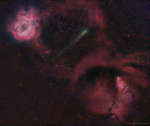 Comet 12P Between Rosette and Cone Nebulas
7.10.2018
Small bits of this greenish-gray comet are expected to streak across Earth's atmosphere tonight. Specifically, debris from the eroding nucleus of Comet 21P / Giacobini-Zinner, pictured, causes the annual Draconids meteor shower, which peaks this evening.
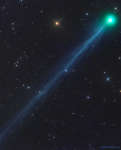 The Ion Tail of New Comet SWAN
28.04.2020
Newly discovered Comet SWAN has already developed an impressive tail. The comet came in from the outer Solar System and has just passed inside the orbit of the Earth. Officially designated C/2020 F8 (SWAN)...
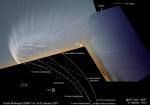 A Tail of Two Hemispheres
31.01.2007
By January 19/20 Comet McNaught's magnificent dust tail stretched for about 150 million kilometers (~1 AU), requiring images from both southern and northern hemispheres of planet Earth to take it all in.
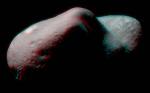 Stereo Eros
16.02.2007
Get out your red/blue glasses and float next to asteroid 433 Eros, now over 220 million kilometers away! Orbiting the Sun once every 1.8 earth-years, asteroid Eros is a diminutive 40 x 14 x 14 kilometer world of undulating horizons, craters, boulders and valleys.
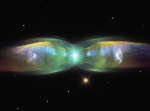 M2 9: Wings of a Butterfly Nebula
15.09.2013
Are stars better appreciated for their art after they die? Actually, stars usually create their most artistic displays as they die. In the case of low-mass stars like our Sun and M2-9 pictured above, the stars transform themselves from normal stars to white dwarfs by casting off their outer gaseous envelopes.
|
January February March April May June July August September |
|||||||||||||||||||||||||||||||||||||||||||||||||