
|
You entered: star formation
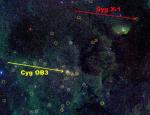 Cyg X-1: Can Black Holes Form in the Dark?
2.04.2005
The formation of a black hole from the collapsing core of a massive star is thought to be heralded by a spectacular supernova explosion. Such an extremely energetic collapse is also a leading explanation for the mysterious cosmic gamma-ray bursts.
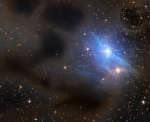 Reflections on vdB 31
11.03.2017
Riding high in the constellation of Auriga, beautiful, blue vdB 31 is the 31st object in Sidney van den Bergh's 1966 catalog of reflection nebulae. It shares this well-composed celestial still life with dark, obscuring clouds recorded in Edward E. Barnard's 1919 catalog of dark markings in the sky.
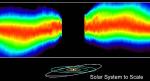 Closer To Beta Pic
22.01.1998
What did our Solar System look like as the planets were forming? Since the 1980s, astronomers have been pointing toward Beta Pictoris, a young, sun-like star a mere 50 light-years distant, as a likely example. Beta Pic is surrounded by a disk of dust which we view nearly edge-on.
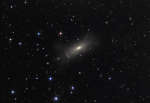 Shell Galaxy NGC 7600
23.12.2011
Similar in size to the Milky Way, elliptical galaxy NGC 7600 is about 150 thousand light-years distant. In this deep image, spanning about 1/2 degree on the sky toward the constellation Aquarius, NGC 7600 sports a remarkable outer halo of nested shells and broad circumgalactic structures.
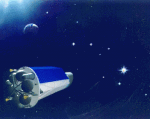 Searching For Solar Systems
15.11.1996
Observational astronomy has recently provided evidence of the existence of massive Jupiter-sized planets orbiting distant suns, protoplanetary disks of gas and dust surrounding newly formed stars, and planetary bodies orbiting exotic stellar corpses known as pulsars. Indeed, the formation of planets seems to be a broader and more varied phenomenon than previously imagined.
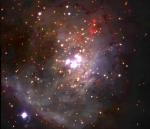 Free Floating Planets In Orion
31.03.2000
This false-colour image of the young Trapezium star cluster in the Orion Nebula was made with an infrared camera at wavelengths about twice as long as visible light. The infrared data are part...
 APOD: 2024 August 7 Б Milky Way Behind Three Merlons
7.08.2024
To some, they look like battlements, here protecting us against the center of the Milky Way. The Three Merlons, also called the Three Peaks of Lavaredo, stand tall today because they are made of dense dolomite rock which has better resisted erosion than surrounding softer rock.
 Reflections on VdB 31
13.02.2025
Riding high in the constellation of Auriga, beautiful, blue VdB 31 is the 31st object in Sidney van den Bergh's 1966 catalog of reflection nebulae. It shares this well-composed celestial still life with dark, obscuring clouds B26, B27, and B28, recorded in Edward E. Barnard's 1919 catalog of dark markings in the sky.
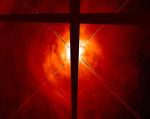 AB Aurigae: How To Make Planets
8.02.2003
This enhanced Hubble Space Telescope image shows in remarkable detail the inner portion of the disk of dust and gas surrounding the star AB Aurigae. Knots of material, visible here for the first time...
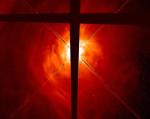 AB Aurigae: How To Make Planets
11.06.1999
This enhanced Hubble Space Telescope image shows in remarkable detail the inner portion of the disk of dust and gas surrounding the star AB Aurigae. Knots of material, visible here for the first time...
|
January February March April May June July August September October |
|||||||||||||||||||||||||||||||||||||||||||||||||