
|
You entered: time
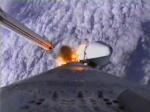 Mars Climate Orbiter Launches
24.12.1998
Looking down from atop a Delta II rocket blasting skyward, solid fuel boosters fall away (left) and the Earth's limb slides into view. These pictures from the launch of the Mars Climate Orbiter were taken as it climbed away from Cape Canaveral Air Station Space Launch Complex 17 on December 11.
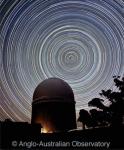 Star Trails in Southern Skies
15.07.2000
As the Earth spins on its axis, the stars seem to rotate around us. This motion produces the beautiful concentric arcs traced out by the stars in this time exposure of the southern hemisphere night sky. In the foreground is the dome of the Anglo-Australian Telescope in central New South Wales, Australia.
 A Cluster Too Far
8.09.1998
Why is this galaxy cluster so red? Nearby clusters have galaxies with colors that are much more yellow and blue. A leading explanation is that this cluster of galaxies lies so far across our universe (z~1) that cosmological time dilation significantly reddens the light.
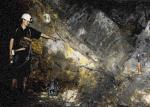 Oklo: Ancient African Nuclear Reactors
20.02.2005
The remnants of nuclear reactors nearly two billion years old were found in the 1970s in Africa. These reactors are thought to have occurred naturally. No natural reactors exist today, as the relative density of fissile uranium has now decayed below that needed for a sustainable reaction.
 The Comet and the Galaxy
14.03.1999
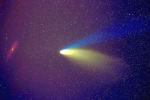
The Moon almost ruined this photograph. During late March and early April 1997, Comet Hale-Bopp passed nearly in front of the Andromeda Galaxy. Here the Great Comet of 1997 and the Great Galaxy in Andromeda were photographed together on 1997 March 24th. The problem was the brightness of the Moon.
 The Comet and the Galaxy
13.08.2006
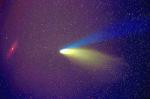
The Moon almost ruined this photograph. During late March and early April 1997, Comet Hale-Bopp passed nearly in front of the Andromeda Galaxy. Here the Great Comet of 1997 and the Great Galaxy in Andromeda were photographed together on 1997 March 24th. The problem was the brightness of the Moon.
 Full Moon Crossing
14.10.2006
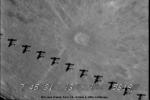
On October 6th, a nearly full perigee Moon shone in Earth's night sky. The bright moonlight, accurate planning, and proper equipment resulted in this amazing composite featuring sharp silhouettes of the International Space Station (ISS) as it rapidly crossed (right to left) in front of the lunar disk.
 The Dark River to Antares
3.06.2008
Connecting the Pipe Nebula to the bright star Antares is a flowing dark cloud nicknamed the Dark River. The murkiness of the Dark River is caused by absorption of background starlight by dust, although the nebula contains mostly hydrogen and molecular gas.
 NGC 6334: The Cats Paw Nebula
13.09.2017
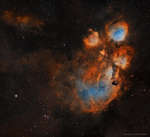
Nebulas are perhaps as famous for being identified with familiar shapes as perhaps cats are for getting into trouble. Still, no known cat could have created the vast Cat's Paw Nebula visible in Scorpius.
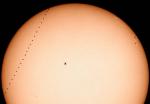 A Mercury Transit Sequence
27.05.2003
Earlier this month, the planet Mercury crossed the face of the Sun, as seen from Earth. Because the plane of Mercury's orbit is not exactly coincident with the plane of Earth's orbit, Mercury usually appears to pass over or under the Sun.
|
January February March April May June July August |
||||||||||||||||||||||||||||||||||||||||||||||||||||||||