
|
You entered: nearest stars
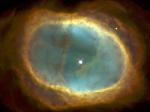 NGC 3132: The Eight Burst Nebula
13.09.2003
It's the dim star, not the bright one, near the center of NGC 3132 that created this odd but beautiful planetary nebula. Nicknamed the Eight-Burst Nebula and the Southern Ring Nebula, the glowing gas originated in the outer layers of a star like our Sun.
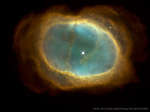 NGC 3132: The Eight Burst Nebula
6.06.2015
It's the dim star, not the bright one, near the center of NGC 3132 that created this odd but beautiful planetary nebula. Nicknamed the Eight-Burst Nebula and the Southern Ring Nebula, the glowing gas originated in the outer layers of a star like our Sun.
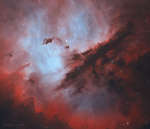 Dust Clouds of the Pacman Nebula
9.08.2022
Stars can create huge and intricate dust sculptures from the dense and dark molecular clouds from which they are born. The tools the stars use to carve their detailed works are high energy light and fast stellar winds.
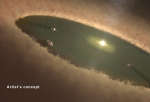 The Double Dust Disks of HD 95086
16.11.2014
What do other star systems look like? To help find out, astronomers are carrying out detailed observations of nearby stars in infrared light to see which have dust disks that might be forming planets.
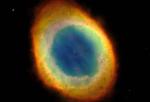 M57: The Ring Nebula
21.03.2003
Except for the rings of Saturn, the Ring Nebula (M57) is probably the most famous celestial band. This planetary nebula's simple, graceful appearance is thought to be due to perspective -- our view from planet Earth looking straight into what is actually a barrel-shaped cloud of gas shrugged off by a dying central star.
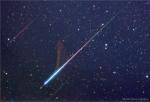 Fireball, Smoke Trail, Meteor Storm
21.11.2001
Returning from orbit, space shuttles enter the atmosphere at about 8 kilometers per second as friction heats their protective ceramic tiles to over 1,400 degrees Celsius. By contrast, the bits of comet dust...
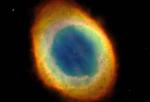 M57: The Ring Nebula
4.07.2004
Except for the rings of Saturn, the Ring Nebula (M57) is probably the most famous celestial band. This planetary nebula's simple, graceful appearance is thought to be due to perspective -- our view from planet Earth looking straight into what is actually a barrel-shaped cloud of gas shrugged off by a dying central star.
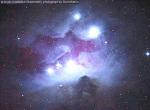 NGC 1977: Blue Reflection Nebula in Orion
22.07.2001
The Orion Nebula is visible to the unaided eye as a fuzzy patch near the famous belt of three stars in the Orion. The above picture captures a part of the Orion Nebula that primarily reflects light from bright Orion stars.
 NGC 4414: A Flocculent Spiral Galaxy
19.11.2016
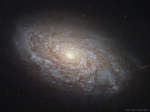
How much mass do flocculent spirals hide? The featured true color image of flocculent spiral galaxy NGC 4414 was taken with the Hubble Space Telescope to help answer this question. The featured image was augmented with data from the Sloan Digital Sky Survey (SDSS).
 APOD: 2004 August 27- The Sedna Scenario
27.08.2004
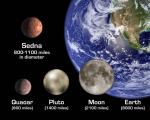
The discovery of Sedna (aka 2003 VB12), the most distant known object orbiting the Sun, presents a mystery. Pluto's orbit averages about 40 AU in radius, where an AU (Astronomical Unit) is the Earth-Sun distance.
|
January February March April May June July August September |
|||||||||||||||||||||||||||||||||||||||||||||||||