
|
You entered: night sky
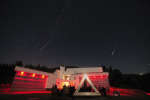 Meteors Over Quebec
16.08.2010
Meteors streaked through the sky above many of Earth's cities last week, but nobody was hurt, and no damage has been reported. The assault from space appeared to originate from someplace in the constellation of Perseus, and included millions of small projectiles hurtling toward Earth at over 200,000 kilometers per hour.
Circumpolarv2comentada1024.preview.jpg) Polaris and the Trail of Comet ZTF
Polaris and the Trail of Comet ZTF
3.02.2023
Stars trace concentric arcs around the North Celestial Pole in this three hour long night sky composite, recorded with a digital camera fixed to a tripod on January 31, near цger, Lleida, Spain. On that date Comet C/2022 E3 (ZTF) was near its northernmost declination in planet Earth's sky.
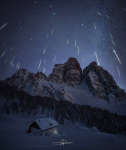 Gemini s Meteors
17.12.2020
Taken over the course of an hour shortly after local midnight on December 13, 35 exposures were used to create this postcard from Earth. The composited night scene spans dark skies above the snowy Italian Dolomites during our fair planet's annual Geminid meteor shower.
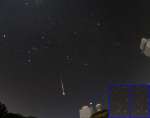 Leonid Fireball over Tenerife
22.11.2011
Historically active, this year's Leonid meteor shower was diminished by bright moonlight. Still, faithful night sky watchers did see the shower peak on November 18 and even the glare of moonlight didn't come close to masking this brilliant fireball meteor.
 Mars, Ceres, Vesta
10.04.2014
That bright, ruddy star you've recently noticed rising just after sunset isn't a star at all. That's Mars, the Red Planet. Mars is now near its 2014 opposition (April 8) and closest approach (April 14), looping through the constellation Virgo opposite the Sun in planet Earth's sky.
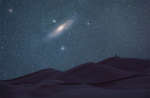 Andromeda over the Sahara Desert
11.07.2022
What is the oldest thing you can see? At 2.5 million light years distant, the answer for the unaided eye is the Andromeda galaxy, because its photons are 2.5 million years old when they reach you.
 A Dark Sky Over Sequoia National Park
27.08.2009
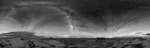
Scroll right to take in the view from the highest summit in the contiguous USA. The above 360-degree digitally stitched panorama, taken in mid-July, shows the view from 4,400-meter high Mt. Whitney in Sequoia National Park, California. In the foreground, angular boulders populate Mt.
 The Rise and Fall of Supernova 2015F
9.02.2016
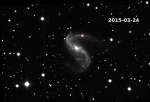
Sit back and watch a star explode. The actual supernova occurred back when dinosaurs roamed the Earth, but images of the spectacular event began arriving last year. Supernova 2015F was discovered in nearby spiral...
 Halley Dust, Mars Dust, and Milky Way
12.05.2023
Grains of cosmic dust streaked through night skies in early May. Swept up as planet Earth plowed through the debris streams left behind by periodic Comet Halley, the annual meteor shower is known as the Eta Aquarids. This year, the Eta Aquarids peak was visually hampered by May's bright Full Moon, though.
 Lewins Challenge: 360 Degree Star Trails
17.07.2011
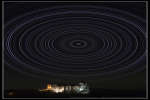
You could be the first person ever to take a real single-exposure image like this. The above image from Vienna, Austria is not real in the sense that the 360 degree star trails in the sky appear only because of a digital trick.
|
January February March April May June July August September October |
|||||||||||||||||||||||||||||||||||||||||||||||||