
|
You entered: shadow
 APOD: 2025 September 12 Б Lunar Eclipse in Two Hemispheres
12.09.2025
September's total lunar eclipse is tracked across night skies from both the northern and southern hemispheres of planet Earth in these two dramatic timelapse series. In the northern hemisphere sequence (top panel) the MoonБs trail arcs from the upper left to the lower right.
 Spot the Moon
2.01.2012
Where's the full Moon? Somewhere in this image, the Earth's Moon is hiding. The entire Moon is visible, in its completely full phase, in plain sight. Even the photographer's keen...
 APOD: 2025 June 29 Б Dark Sand Cascades on Mars
29.06.2025
Are these trees growing on Mars? No. Groups of dark brown streaks have been photographed by the Mars Reconnaissance Orbiter on melting pinkish sand dunes covered with light frost. The featured image was taken in 2008 April near the North Pole of Mars.
 Supermoon Total Lunar Eclipse and Lightning Storm
29.09.2015
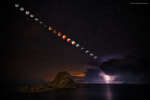
What's more rare than a supermoon total lunar eclipse? How about a supermoon total lunar eclipse over a lightning storm. Such an electrifying sequence was captured yesterday from Ibiza, an island in southeastern Spain.
 Orion and the Ocean of Storms
13.12.2025
On December 5, 2022, a camera on board the uncrewed Orion spacecraft captured this view as Orion approached its return powered flyby of the Moon. Beyond one of Orion's extended solar arrays lies dark, smooth, terrain along the western edge of the Oceanus Procellarum.
 The Mineral Moon
29.08.2003
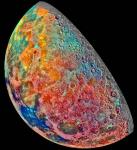
Even if the Moon really were made of green cheese it probably wouldn't look this bizarre. Still, this mosaic of 53 images was recorded by the Jupiter-bound Galileo spacecraft as it passed near our own large natural satellite in 1992.
 A Perseid Meteor
11.08.2004
The ongoing Perseid Meteor Shower should be at its strongest tonight and tomorrow night. Although meteors should be visible all night long, the best time to watch will be between 2:00 AM and dawn each night. In dark, moonless, predawn skies you may see dozens of meteors per hour.
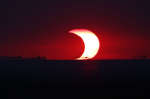 A Partial Eclipse Over Manila Bay
20.05.2012
What's happened to the setting Sun? An eclipse! In early 2009, the Moon eclipsed part of the Sun as visible from parts of Africa, Australia, and Asia. In particular the above image, taken from the Mall of Asia seawall, caught a partially eclipsed Sun setting over Manila Bay in the Philippines.
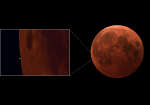 Blood Moon, Ice Giant
11.11.2022
On November 8 the Full Moon turned blood red as it slid through Earth's shadow in a beautiful total lunar eclipse. During totality it also passed in front of, or occulted, outer planet Uranus for eclipse viewers located in parts of northern America and Asia.
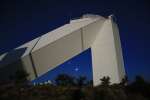 Bright Planets at McMath Pierce Solar Telescope
16.03.2012
Bright planets Venus and Jupiter are framed by the National Solar Observatory's McMath-Pierce Solar Telescope in this very astronomical scene. The photo was taken at Kitt Peak National Observatory on March 9.
|
January February March April May June July August September October |
|||||||||||||||||||||||||||||||||||||||||||||||||