
|
You entered: star
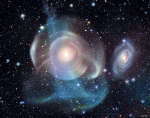 Galaxy NGC 474: Shells and Star Streams
6.02.2018
What's happening to galaxy NGC 474? The multiple layers of emission appear strangely complex and unexpected given the relatively featureless appearance of the elliptical galaxy in less deep images. The cause...
 APOD: 2023 April 11 Б North Star: Polaris and Surrounding Dust
11.04.2023
Why is Polaris called the North Star? First, Polaris is the nearest bright star toward the north spin axis of the Earth. Therefore, as the Earth turns, stars appear to revolve around Polaris, but Polaris itself always stays in the same northerly direction -- making it the North Star.
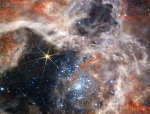 Tarantula Stars R136 from Webb
7.09.2022
Near the center of a nearby star-forming region lies a massive cluster containing some of the largest and hottest stars known. Collectively known as star cluster NGC 2070, these stars are part of the vast Tarantula Nebula and were captured in two kinds of infrared light by the new Webb Space Telescope.
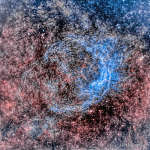 The Asymmetric Nebula Surrounding Wolf Rayet Star 18
9.11.2022
Why does the nebula around the star WR-18 shine brighter on one side? Also known as NGC 3199, this active star and its surrounding nebula lie about 12,000 light-years away toward the nautical southern constellation of Carina.
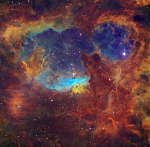 Massive Stars in NGC 6357
5.02.2016
Massive stars lie within NGC 6357, an expansive emission nebula complex some 6,500 light-years away toward the tail of the constellation Scorpius. In fact, positioned near center in this ground-based close-up...
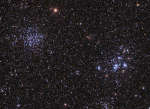 M46 and M47: Star Clusters Young and Old
3.04.2012
Many stars form in clusters. Galactic or open star clusters are relatively young swarms of bright stars born together near the plane of our Milky Way Galaxy. Separated by about a degree...
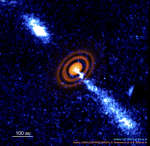 HD 163296: Jet from a Star in Formation
22.06.2021
How are jets created during star formation? No one is sure, although recent images of the young star system HD 163296 are quite illuminating. The central star in the featured image is still forming but seen already surrounded by a rotating disk and an outward moving jet.
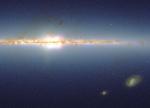 Counting Stars in the Infrared Sky
19.07.2002
The bulging center of our Milky Way Galaxy, dark cosmic clouds, the thin galactic plane, and even nearby galaxies are easy to spot in this sky view. But each pixel in the digital image is actually based on star counts alone -- as derived from the Two Micron All Sky Survey (2MASS) database.
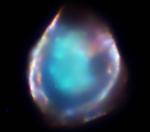 DEM L71: When Small Stars Explode
14.03.2003
Large, massive stars end their furious lives in spectacular supernova explosions -- but small, low mass stars may encounter a similar fate. In fact, instead of simply cooling off and quietly fading away, some white...
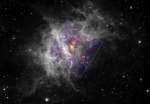 Young Star Cluster Westerlund 2
26.06.2010
Dusty stellar nursery RCW 49 surrounds young star cluster Westerlund 2 in this remarkable composite skyscape from beyond the visible spectrum of light. Infrared data from the Spitzer Space Telescope is shown in black...
|
January February March April May June July August September October |
|||||||||||||||||||||||||||||||||||||||||||||||||