
|
You entered: star formation
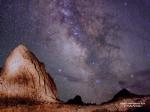 The Milky Way over Utah
1.08.2006
If sometimes it appears that the entire Milky Way Galaxy is raining down on your head, do not despair. It happens twice a day. As the Sun rises in the East, wonders of the night sky become less bright than the sunlight scattered by our own Earth's atmosphere, and so fade from view.
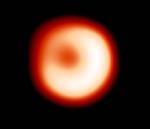 LkHa101: The Hole in the Doughnut
2.03.2001
You'd need a really big cup of coffee with this doughnut ... because the hole in the middle is about a billion kilometers across. Centered on the Sun, a circle that size would lie between the orbits of Mars and Jupiter.
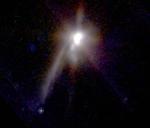 An Extrasolar Planet?
29.05.1998
This infrared Hubble Space Telescope view may contain the first ever direct image of a planet outside our own solar system. The picture shows a very young double star located about 450 light-years away toward the constellation of Taurus.
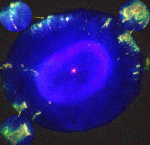 Fliers Around the Blue Snowball Nebula
22.11.1996
Planetary nebulae are strange. First, they are gas clouds and have nothing to do with our Solar System's planets. Next, although hundreds of planetary nebulae have been catalogued and thousands surely exist in our Galaxy, aspects of the formation process are still debated.
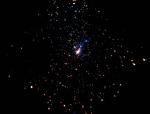 X Ray Stars in the Orion Nebula
19.05.2005
When our middle-aged Sun was just a few million years old it was thousands of times brighter in x-rays. In fact, it was likely similar to some of the stars found in this false-color x-ray composite of the Orion Nebula region from the Chandra Observatory.
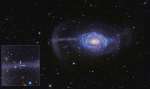 NGC 4651: The Umbrella Galaxy
2.07.2014
Spiral galaxy NGC 4651 is a mere 62 million light-years distant, toward the well-groomed northern constellation Coma Berenices. About the size of our Milky Way, this island universe is seen to have a faint umbrella-shaped structure that seems to extend (left) some 100 thousand light-years beyond the bright galactic disk.
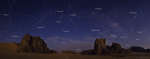 Saharan Starry Night
27.06.2009
This panoramic image of a starry night looks across a dry, desolate landscape. The magnificent view was recorded from Tassili National Park, in the heart of the Sahara desert in southern Algeria. Rising above...
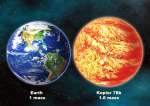 Kepler 78b: Earth Sized Planet Discovered
5.11.2013
Even though Kepler-78b is only slightly larger than the Earth, it should not exist. Its size is extraordinary only in the sense that it is the most similar in size to the Earth of any exoplanet yet directly discovered.
 Young Star, Dark Cloud
26.12.2003
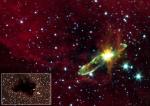
High-speed outflows of molecular gas from a young stellar object glow in infrared light, revealing themselves in this recent false-color image from the Spitzer Space Telescope. Cataloged as HH (Herbig-Haro) 46/47 the infrared source...
 M82 s Middle Mass Black Hole
14.09.2000
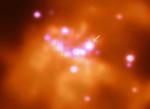
Black holes are probably the most bizarre creatures in the modern astronomical zoo. And after years of pondering black holes as either stellar mass objects seen in binary star systems or enormous supermassive black holes at the centers of galaxies, astronomers now have strong evidence
|
January February March April May June July August September October |
|||||||||||||||||||||||||||||||||||||||||||||||||