
|
You entered: Earth's moon
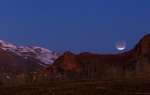 Eclipsed Moon in the Morning
9.12.2011
Tomorrow, December 10, the Full Moon will slide through planet Earth's shadow in a total lunar eclipse. The entire eclipse sequence, including 51 minutes of totality, will be visible from Asia and Australia...
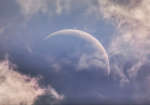 APOD: 2026 June 20 Б Daytime Moon Meets Evening Star
20.06.2026
Venus is now appearing on the celestial stage as Earth's brilliant evening star, performing with the Moon, other wandering planets, and bright stars in western skies. For evening sky gazers on June 17, the celestial beacon rose after sunset close by a young, slender, crescent Moon.
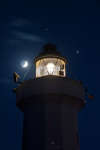 Great Conjunction over Sicilian Lighthouse
8.12.2020
DonБt miss the coming great conjunction. In just under two weeks, the two largest planets in our Solar System will angularly pass so close together in Earth's sky that the Moon would easily be able to cover them both simultaneously. This pending planetary passage -- on December 21 -- will be the closest since 1623.
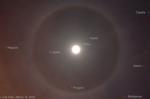 Stars and Planets in the Halo of the Moon
21.03.2003
Photographed on March 13th from Caledon, Ontario, Canada, a bright Moon was surrounded by this lovely halo. Planet Jupiter and stars Procyon, Castor, and Pollux also appear within the circle of lunar light. Castor...
 APOD: 2025 March 16 Б Venus and the Triply Ultraviolet Sun
16.03.2025
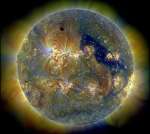
This was a very unusual type of solar eclipse. Typically, it is the Earth's Moon that eclipses the Sun. In 2012, though, the planet Venus took a turn. Like a solar eclipse by the Moon, the phase of Venus became a continually thinner crescent as Venus became increasingly better aligned with the Sun.
 Venus and the Triply Ultraviolet Sun
20.08.2013
An unusual type of solar eclipse occurred last year. Usually it is the Earth's Moon that eclipses the Sun. Last June, most unusually, the planet Venus took a turn. Like a solar eclipse by the Moon, the phase of Venus became a continually thinner crescent as Venus became increasingly better aligned with the Sun.
 A Digital Lunar Eclipse
19.05.2022
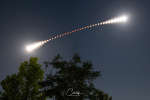
Recorded on May 15/16 this sequence of exposures follows the Full Moon during a total lunar eclipse as it arcs above treetops in the clearing skies of central Florida. A frame taken every 5 minutes by a digital camera shows the progression of the eclipse over three hours.
 Venus and the Triply Ultraviolet Sun
4.02.2018
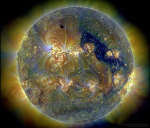
An unusual type of solar eclipse occurred in 2012. Usually it is the Earth's Moon that eclipses the Sun. That year, most unusually, the planet Venus took a turn. Like a solar eclipse by the Moon, the phase of Venus became a continually thinner crescent as Venus became increasingly better aligned with the Sun.
 Shuttle Plume Shadow Points to Moon
3.06.2007
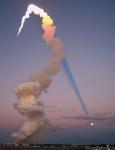
Why would the shadow of a space shuttle launch plume point toward the Moon? In early 2001 during a launch of Atlantis, the Sun, Earth, Moon, and rocket were all properly aligned for this photogenic coincidence.
 APOD: 2025 July 24 Б Titan Shadow Transit
24.07.2025
Every 15 years or so, Saturn's rings are tilted edge-on to our line of sight. As the bright, beautiful ring system grows narrower and fainter it becomes increasingly difficult to see for denizens of planet Earth.
|
January February March April May June July August September |
|||||||||||||||||||||||||||||||||||||||||||||||||