
|
You entered: Earth orbit
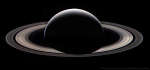 Saturn at Night
20.09.2019
Still bright in planet Earth's night skies, good telescopic views of Saturn and its beautiful rings often make it a star at star parties. But this stunning view of Saturn's rings and night side just isn't possible from telescopes closer to the Sun than the outer planet.
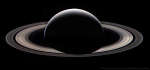 Saturn at Night
11.09.2021
Still bright in planet Earth's night skies, good telescopic views of Saturn and its beautiful rings often make it a star at star parties. But this stunning view of Saturn's rings and night side just isn't possible from telescopes closer to the Sun than the outer planet.
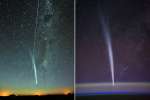 Comet Lovejoy and the ISS
31.12.2011
On December 24, Comet Lovejoy rose in dawn's twilight, arcing above the eastern horizon, its tails swept back by the solar wind and sunlight. Seen on the left is the comet's early morning appearance alongside the southern Milky Way from the town of Intendente Alvear, La Pampa province, Argentina.
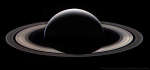 Saturn at Night
26.11.2022
Saturn is still bright in planet Earth's night skies. Telescopic views of the distant gas giant and its beautiful rings often make it a star at star parties. But this stunning view of Saturn's rings and night side just isn't possible from telescopes closer to the Sun than the outer planet.
 Gamma Ray Earth
31.03.2005
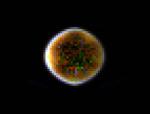
The pixelated planet above is actually our own planet Earth seen in gamma rays - the most energetic form of light. In fact, the gamma rays used to construct this view pack over 35 million electron volts (MeV) compared to a mere two electron volts (eV) for a typical visible light photon.
 The Cone Nebula from Hubble
28.05.2014
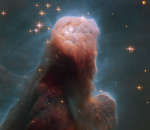
Stars are forming in the gigantic dust pillar called the Cone Nebula. Cones, pillars, and majestic flowing shapes abound in stellar nurseries where natal clouds of gas and dust are buffeted by energetic winds from newborn stars. The Cone Nebula, a well-known example, lies within the bright galactic star-forming region NGC 2264.
 Rings and Seasons of Saturn
21.06.2015
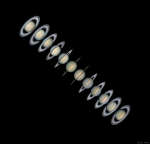
On Saturn, the rings tell you the season. On Earth, today marks a solstice, the time when the Earth's spin axis tilts directly toward the Sun. On Earth's northern hemisphere, today is the Summer Solstice, the day of maximum daylight.
 Hubble s Messier 5
4.11.2017
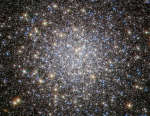
"Beautiful Nebula discovered between the Balance [Libra] & the Serpent [Serpens] ..." begins the description of the 5th entry in 18th century astronomer Charles Messier's famous catalog of nebulae and star clusters. Though it appeared...
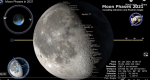 Moon Phases in 2021
11.01.2021
What will the Moon phase be on your birthday this year? It is hard to predict because the Moon's appearance changes nightly. As the Moon orbits the Earth, the half illuminated by the Sun first becomes increasingly visible, then decreasingly visible.
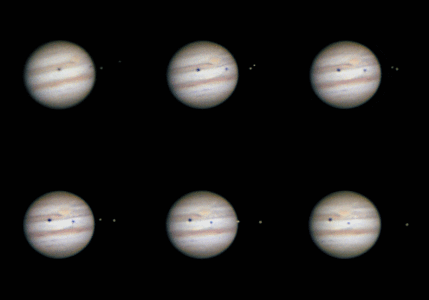 When Moons and Shadows Dance
27.02.2003
It's no wonder Jupiter is a favorite target for even modest earthbound telescopes. The most massive planet in the solar system with four of the largest moons also boasts the famous Great Red Spot, a giant hurricane-like storm system over three hundred years old.
|
January February March April May June July August September October |
|||||||||||||||||||||||||||||||||||||||||||||||||