
|
You entered: atmosphere
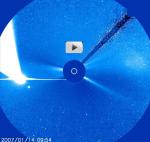 SOHO: Comet McNaught Movie
20.01.2007
This frame from a spectacular time lapse movie shows Comet McNaught - the Great Comet of 2007 - sweeping through the inner solar system. The movie frames were recorded from January 12 through Jan 16 by a coronograph onboard the sun-staring SOHO spacecraft.
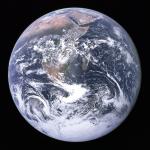 Welcome to Planet Earth
25.03.2007
Welcome to Planet Earth, the third planet from a star named the Sun. The Earth is shaped like a sphere and composed mostly of rock. Over 70 percent of the Earth's surface is water. The planet has a relatively thin atmosphere composed mostly of nitrogen and oxygen.
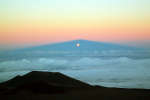 Moonrise Through Mauna Keas Shadow
5.12.2010
How can the Moon rise through a mountain? It cannot -- what was photographed here is a moonrise through the shadow of a large volcano. The volcano is Mauna Kea, Hawai'i, USA, a frequent spot for spectacular photographs since it is arguably the premier observing location on planet Earth.
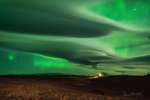 Aurora over Clouds
24.11.2015
Auroras usually occur high above the clouds. The auroral glow is created when fast-moving particles ejected from the Sun impact the Earth's magnetosphere, from which charged particles spiral along the Earth's magnetic field to strike atoms and molecules high in the Earth's atmosphere.
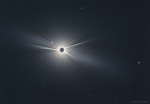 Wide Field View of Great American Eclipse
30.01.2019
Only in the fleeting darkness of a total solar eclipse is the light of the solar corona easily visible. Normally overwhelmed by the bright solar disk, the expansive corona, the sun's outer atmosphere, is an alluring sight.
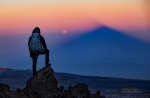 Moonrise and Mountain Shadow
14.03.2020
What phase of the Moon is 3.14 radians from the Sun? The Full Moon, of course. Even though the Moon might look full for several days, the Moon is truly at its full phase when it is 3.14 radians (aka 180 degrees) from the Sun in ecliptic longitude.
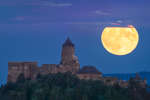 Lubovna Full Moon
15.07.2022
On July 13 this well-planned telephoto view recorded a Full Moon rising over Lubovna Castle in eastern Slovakia. The photographer was about 3 kilometers from the castle walls and about 357,000 kilometers from this Full Moon near perigee, the closest point in its elliptical orbit.
 APOD: 2023 October 18 Б Dust and the Western Veil Nebula
18.10.2023
It's so big it is easy to miss. The entire Veil Nebula spans six times the diameter of the full moon, but is so dim you need binoculars to see it. The nebula was created about 15,000 years ago when a star in the constellation of the Swan (Cygnus) exploded.
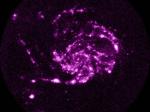 M101: An Ultraviolet View
10.06.2000
This picture of giant spiral galaxy Messier 101 (M101) was taken by the Ultraviolet Imaging Telescope (UIT). UIT flew into orbit as part of the Astro 2 mission on-board the Space Shuttle Endeavour in March 1995.
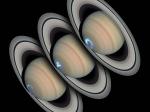 Persistent Saturnian Auroras
22.02.2005
Are Saturn's auroras like Earth's? To help answer this question, the Hubble Space Telescope and the Cassini spacecraft monitored Saturn's South Pole simultaneously as Cassini closed in on the gas giant in January 2004. Hubble snapped images in ultraviolet light, while Cassini recorded radio emissions and monitored the solar wind.
|
January February March April May June July August September October |
|||||||||||||||||||||||||||||||||||||||||||||||||