
|
You entered: dark cloud
 Planet Earth at Twilight
22.04.2020
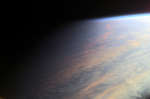
No sudden, sharp boundary marks the passage of day into night in this gorgeous view of ocean and clouds over our fair planet Earth. Instead, the shadow line or terminator is diffuse and shows the gradual transition to darkness we experience as twilight.
 Planet Earth at Twilight
22.04.2022
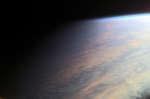
No sudden, sharp boundary marks the passage of day into night in this gorgeous view of ocean and clouds over our fair planet Earth. Instead, the shadow line or terminator is diffuse and shows the gradual transition to darkness we experience as twilight.
 Stardust in Perseus
29.11.2007
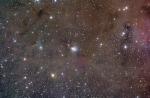
This cosmic expanse of dust, gas, and stars covers some 4 degrees on the sky in the heroic constellation Perseus. Centered in the gorgeous skyscape is the dusty blue reflection nebula NGC 1333, about 1,000 light-years away. At that estimated distance, the field of view is nearly 70 light-years across.
 M43: Streams of Orion
6.10.2021
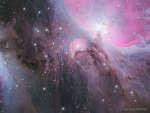
Where do the dark streams of dust in the Orion Nebula originate? This part of the Orion Molecular Cloud Complex, M43, is the often imaged but rarely mentioned neighbor of the more famous M42. M42, seen in part to the upper right, includes many bright stars from the Trapezium star cluster.
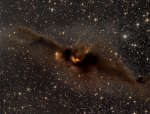 LDN 43: The Cosmic Bat Nebula
31.10.2022
What is the most spook-tacular nebula in the galaxy? One contender is LDN 43, which bears an astonishing resemblance to a vast cosmic bat flying amongst the stars on a dark Halloween night. Located...
 Alnitak, Alnilam, Mintaka
20.11.2025
Alnitak, Alnilam, and Mintaka are the bright bluish stars from east to west (upper right to lower left) along the diagonal in this cosmic vista. Otherwise known as the Belt of Orion, these three blue supergiant stars are hotter and much more massive than the Sun.
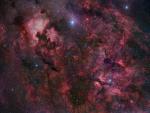 Northern Cygnus
20.09.2007
Bright, hot, supergiant star Deneb lies at top center in this gorgeous skyscape. The 20 frame mosaic spans an impressive 12 degrees across the northern end of Cygnus the Swan. Crowded with stars...
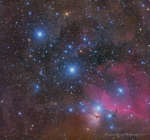 Alnitak, Alnilam, Mintaka
23.11.2017
Alnitak, Alnilam, and Mintaka, are the bright bluish stars from east to west (lower right to upper left) along the diagonal in this cosmic vista. Otherwise known as the Belt of Orion, these three blue supergiant stars are hotter and much more massive than the Sun.
 APOD: 2024 October 27 Б LDN 43: The Cosmic Bat Nebula
27.10.2024
What is the most spook-tacular nebula in the galaxy? One contender is LDN 43, which bears an astonishing resemblance to a vast cosmic bat flying amongst the stars on a dark Halloween night. Located...
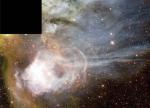 N44C: A Nebular Mystery
14.05.2002
Why is N44C glowing so strangely? The star that appears to powers the nebula, although young and bright, does not seem hot enough to create some of the colors observed. A search for a hidden hotter star in X-rays has come up empty.
|
January February March April May June July August September October |
|||||||||||||||||||||||||||||||||||||||||||||||||