
|
You entered: ring galaxy
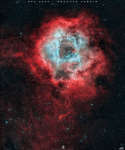 Roses are Red
14.02.2026
Roses are red, nebulas are too, and this Valentine's gift is a stunning view! Pictured is a loving look at the Rosette Nebula (NGC 2237): a cosmic bloom of bright young stars sitting atop a stem of glowing hot gas.
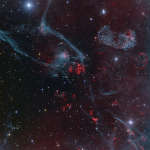 Puppis A Supernova Remnant
29.09.2017
Driven by the explosion of a massive star, supernova remnant Puppis A is blasting into the surrounding interstellar medium about 7,000 light-years away. At that distance, this colorful telescopic field based on broadband and narrowband optical image data is about 60 light-years across.
 Puppis A Supernova Remnant
28.08.2015
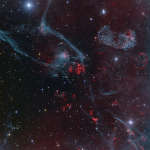
Driven by the explosion of a massive star, supernova remnant Puppis A is blasting into the surrounding interstellar medium about 7,000 light-years away. At that distance, this colorful telescopic field based on broadband and narrowband optical image data is about 60 light-years across.
 The Heart and Soul Nebulas
14.09.2008
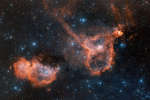
Is the heart and soul of our Galaxy located in Cassiopeia? Possibly not, but that is where two bright emission nebulas nicknamed Heart and Soul can be found. The Heart Nebula, officially dubbed IC 1805 and visible in the above zoomable view on the right, has a shape reminiscent of a classical heart symbol.
 Optical Transient Near GRB970508 Shows Distant Redshift
13.05.1997
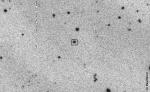
The GRB distance scale controversy may have just ended with a flash. Gamma Ray Bursts (GRBs) are powerful explosions occurring in seemingly random positions on the sky. They are so featureless and so poorly resolved, however, that their distances could not be determined.
 Polaris Dust Nebula
11.01.2008
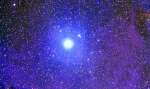
Centered on North Star Polaris, this 4 degree wide field of view covers part of a complex of relatively unfamiliar, diffuse dust clouds soaring high above the plane of our Milky Way Galaxy.
 Globular Cluster 47 Tucanae
19.09.1997
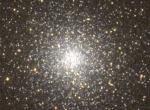
Stars come in bunches. Of the over 200 globular star clusters that orbit the center of our Milky Way Galaxy, 47 Tucanae is the second brightest globular cluster (behind Omega Centauri). Known to some affectionately as 47 Tuc or NGC 104, it is only visible from the Southern Hemisphere.
 Globular Cluster 47 Tucanae
22.04.2001
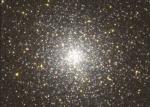
Stars come in bunches. Of the over 200 globular star clusters that orbit the center of our Milky Way Galaxy, 47 Tucanae is the second brightest globular cluster (behind Omega Centauri). Known to some affectionately as 47 Tuc or NGC 104, it is only visible from the Southern Hemisphere.
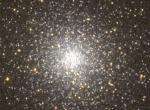 Globular Cluster 47 Tucanae
7.11.1998
Stars come in bunches. Of the over 200 globular star clusters that orbit the center of our Milky Way Galaxy, 47 Tucanae is the second brightest globular cluster (behind Omega Centauri). Known to some affectionately as 47 Tuc or NGC 104, it is only visible from the Southern
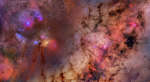 Scorpius Enhanced
16.06.2021
If Scorpius looked this good to the unaided eye, humans might remember it better. Scorpius more typically appears as a few bright stars in a well-known but rarely pointed out zodiacal constellation. To get a spectacular image like this, though, one needs a good camera, a dark sky, and some sophisticated image processing.
|
January February March April May June July August September October |
|||||||||||||||||||||||||||||||||||||||||||||||||