
|
You entered: star system
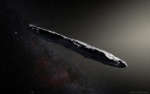 APOD: 2017 November 22 Oumuamua: Interstellar Asteroid
22.11.2017
Nothing like it has ever been seen before. The unusual space rock 'Oumuamua is so intriguing mainly because it is the first asteroid ever detected from outside our Solar System -- although likely many more are to follow given modern computer-driven sky monitoring.
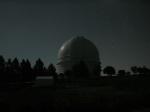 Palomar at Night
7.08.2003
What's wrong with this picture? The summer night sky is clear, and moonlight illuminates the dome of the Hale 200-inch Telescope at Palomar Observatory, northeast of San Diego, California, USA. The familiar stars of the Teapot asterism in the constellation Sagittarius shine above the dome and to the right.
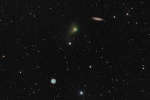 The Comet, the Owl, and the Galaxy
21.04.2016
Comet C/2014 S2 (PanSTARRS) poses for a Messier moment in this telescopic snapshot from April 18. In fact it shares the 1.5 degree wide field-of-view with two well-known entries in the 18th century comet-hunting astronomer's famous catalog.
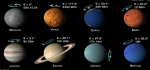 Planets of the Solar System: Tilts and Spins
20.05.2019
How does your favorite planet spin? Does it spin rapidly around a nearly vertical axis, or horizontally, or backwards? The featured video animates NASA images of all eight planets in our Solar System to show them spinning side-by-side for an easy comparison.
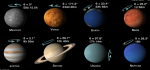 Planets of the Solar System: Tilts and Spins
11.09.2022
How does your favorite planet spin? Does it spin rapidly around a nearly vertical axis, or horizontally, or backwards? The featured video animates NASA images of all eight planets in our Solar System to show them spinning side-by-side for an easy comparison.
 Artistic Impression: The Surface of TRAPPIST 1f
26.06.2017
If you could stand on the surface of the newly discovered Earth-sized exoplanet TRAPPIST-1f, what would you see? Presently, no Earthling knows for sure, but the featured illustration depicts a reasoned guess based on observational data taken by NASA's Sun-orbiting Spitzer Space Telescope.
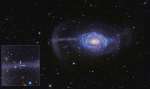 NGC 4651: The Umbrella Galaxy
2.07.2014
Spiral galaxy NGC 4651 is a mere 62 million light-years distant, toward the well-groomed northern constellation Coma Berenices. About the size of our Milky Way, this island universe is seen to have a faint umbrella-shaped structure that seems to extend (left) some 100 thousand light-years beyond the bright galactic disk.
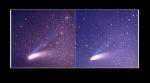 Hale-Bopp in Stereo
4.04.1997
This stereo pair of Hale-Bopp images combines two pictures from slightly different viewing angles. Simulating stereo vision, the difference was generated by the comet's apparent motion as it cruised through the inner Solar System.
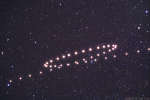 Retrograde Mars
13.06.2010
Why would Mars appear to move backwards? Most of the time, the apparent motion of Mars in Earth's sky is in one direction, slow but steady in front of the far distant stars. About every two years, however, the Earth passes Mars as they orbit around the Sun.
 Retrograde Mars
11.05.2008
Why would Mars appear to move backwards? Most of the time, the apparent motion of Mars in Earth's sky is in one direction, slow but steady in front of the far distant stars. About every two years, however, the Earth passes Mars as they orbit around the Sun.
|
January February March April May June July August September October |
|||||||||||||||||||||||||||||||||||||||||||||||||