
|
You entered: Earth's moon
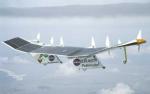 ERAST Pathfinder Plus: Daedalus Defied
12.08.1998
Daedalus warned Icarus that if he flew too high, the Sun would melt his wings. Apparently, nobody gave the ERAST Pathfinder-Plus aircraft a similar warning. Earlier this month, not only did Pathfinder-Plus fly higher than any previous propeller-driven aircraft - its wings converted sunlight into power.
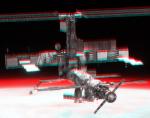 3D International Space Station
27.08.2005
Get out your red-blue glasses and float next to the International Space Station (ISS), planet Earth's largest artificial moon. This breathtaking stereo view was constructed from two separate images (S114-E-7245, S114-E-7246) recorded as the shuttle orbiter Discovery undocked from the ISS on August 6.
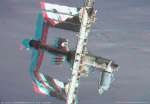 Stereo Space Station
23.02.2008
Get out your red-blue glasses and float next to the International Space Station (ISS), planet Earth's largest artificial moon. This fun stereo view was constructed from parts of two separate images (S122-E-009880, S122-E-009893) and an additional background recorded as the shuttle orbiter Atlantis undocked from the ISS on February 18.
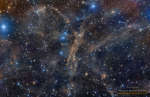 A Dust Angel Nebula
28.04.2016
The combined light of stars along the Milky Way are reflected by these cosmic dust clouds that soar some 300 light-years or so above the plane of our galaxy. Dubbed the Angel Nebula, the faint apparition is part of an expansive complex of dim and relatively unexplored, diffuse molecular clouds.
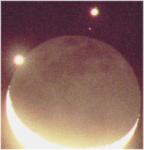 Occultations and Rising Moons
13.05.1998
On April 23, the rising crescent Moon occulted (passed in front of) Venus and Jupiter. The double occultation was a rare event and only visible from certain locations tracing a path across Earth's surface. This dramatic telephoto picture was taken at one such location, Ascension Island in the South Atlantic.
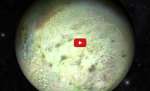 Flying Past Neptunes Moon Triton
26.08.2014
What would it look like to fly past Triton, the largest moon of planet Neptune? Only one spacecraft has ever done this -- and now, for the first time, images of this dramatic encounter have been gathered into a movie. On 1989 August 25, the Voyager 2 spacecraft shot through the Neptune system with cameras blazing.
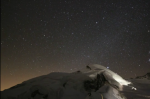 Geostationary Satellites Beyond the Alps
11.04.2012
Why don't those stars move? Stars in the sky will typically appear to rise and set as the Earth turns. Those far to the north or south will appear to circle the pole. If you look closely at the above time-lapse movie, however, there are points of light that appear stationary.
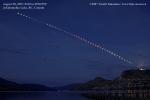 Kalamalka Lake Eclipse
1.09.2007
Recorded on August 28th, this serene total lunar eclipse sequence looks southwest down Kalamalka Lake toward the lights of Coldstream, British Columbia. An exposure every 4 minutes captured the Moon's position and eclipse phase, until the Moon set behind the town lights and a hill on the horizon.
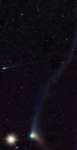 Comets and Bright Star
6.01.2016
This timely, telescopic, two panel mosaic spans about 10 full moons across planet Earth's predawn skies. Recorded as the year began from Tenerife, Canary Islands, near the top of the frame are the faint coma and tail of Comet Borrelly (P/19).
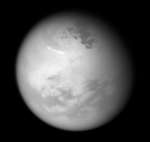 Northern Summer on Titan
20.06.2020
Today's solstice brings summer to planet Earth's northern hemisphere. But the northern summer solstice arrived for ringed planet Saturn over three years ago on May 24, 2017. Orbiting the gas giant, Saturn's moon Titan experiences the Saturnian seasons.
|
January February March April May June July August September |
|||||||||||||||||||||||||||||||||||||||||||||||||