
|
You entered: composite image
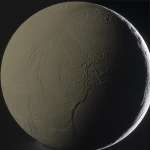 Enceladus Backlit by Saturn
8.02.2012
This moon is shining by the light of its planet. Specifically, a large portion of Enceladus pictured above is illuminated primarily by sunlight first reflected from the planet Saturn. The result is that the normally snow-white moon appears in the gold color of Saturn's cloud tops.
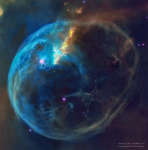 The Bubble Nebula from Hubble
22.03.2022
Massive stars can blow bubbles. The featured image shows perhaps the most famous of all star-bubbles, NGC 7635, also known simply as The Bubble Nebula. Although it looks delicate, the 7-light-year diameter bubble offers evidence of violent processes at work.
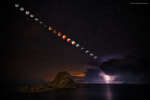 Supermoon Total Lunar Eclipse and Lightning Storm
28.09.2015
What's more rare than a supermoon total lunar eclipse? How about a supermoon total lunar eclipse over a lightning storm. Such an electrifying sequence was captured yesterday from Ibiza, an island in southeastern Spain.
 A Total Solar Eclipse of Saros 145
10.08.2017
A darkened sky holds bright planet Venus, the New Moon in silhouette, and the shimmering corona of the Sun in this image of a total solar eclipse. A composite of simultaneous telephoto and wide angle frames it was taken in the path of totality 18 years ago, August 11, 1999, near Kastamonu, Turkey.
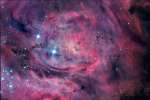 M8: The Lagoon Nebula
5.08.2010
This beautiful cosmic cloud is a popular stop on telescopic tours of the constellation Sagittarius. Eighteenth century cosmic tourist Charles Messier cataloged the bright nebula as M8. Modern day astronomers recognize the Lagoon Nebula as an active stellar nursery about 5,000 light-years distant, in the direction of the center of our Milky Way Galaxy.
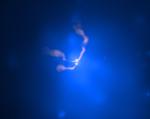 Binary Black Hole in 3C 75
12.04.2006
The two bright sources at the center of this composite x-ray (blue)/ radio (pink) image are co-orbiting supermassive black holes powering the giant radio source 3C 75. Surrounded by multimillion degree x-ray emitting gas, and blasting out jets of relativistic particles the supermassive black holes are separated by 25,000 light-years.
 APOD is 15 Years Old Today
16.06.2010
Welcome to the quindecennial year of the Astronomy Picture of the Day! Perhaps a source of web consistency for some, APOD is still here. As during each of the 15 years of selecting images...
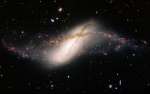 Polar Ring Galaxy NGC 660
10.11.2012
NGC 660 is featured in this cosmic snapshot, a sharp composite of broad and narrow band filter image data from the Gemini North telescope on Mauna Kea. Over 20 million light-years away and swimming within the boundaries of the constellation Pisces, NGC 660's peculiar appearance marks it as a polar ring galaxy.
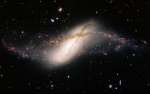 Polar Ring Galaxy NGC 660
7.11.2014
NGC 660 is featured in this cosmic snapshot, a sharp composite of broad and narrow band filter image data from the Gemini North telescope on Mauna Kea. Over 20 million light-years away and swimming within the boundaries of the constellation Pisces, NGC 660's peculiar appearance marks it as a polar ring galaxy.
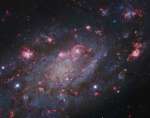 NGC 2403 in Camelopardalis
23.07.2011
Magnificent island universe NGC 2403 stands within the boundaries of the long-necked constellation Camelopardalis. Some 10 million light-years distant and about 50,000 light-years across, the spiral galaxy also seems to have more than its fair share of giant star forming HII regions, marked by the telltale reddish glow of atomic hydrogen gas.
|
January February March April May June July August |
||||||||||||||||||||||||||||||||||||||||||||||||||||||||