
|
You entered: massive stars
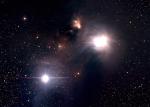 Dust and Gas Surrounding Star R Coronae Australis
16.10.2000
Young star R Coronae Australis has a dusty home. The dust is so thick on the upper left of the above photograph that little light from background stars comes through. Thinner dust near the stars reflects light from R Coronae Australis (upper right) and neighbor TY Coronae Australis, giving their surroundings a flowing appearance.
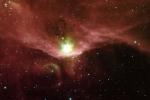 Sharpless 140
20.05.2004
Three young, massive stars will eventually emerge from this natal cloud of dust and gas, but their presence is already revealed in this false-color image from the Spitzer Space Telescope. The picture offers...
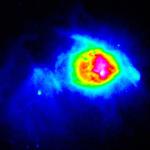 Hydrogen Blob N88A in the Small Magellanic Cloud
29.07.1999
The bright blob of hydrogen gas cataloged as N88A is seen at the right. It measures a mere 3 light years across. Emerging from the cool, dusty interstellar medium in a nearby irregular galaxy known as the Small Magellanic Cloud, N88A hides hot young stars at its core.
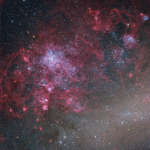 The Tarantula Zone
12.06.2014
The Tarantula Nebula is more than 1,000 light-years in diameter, a giant star forming region within our neighboring galaxy the Large Magellanic Cloud (LMC). That cosmic arachnid lies toward the upper left in this deep and colorful telescopic view made through broad-band and narrow-band filters.
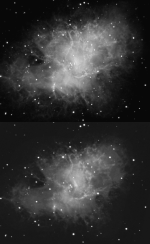 The Incredible Expanding Crab
27.12.2001
The Crab Nebula is cataloged as M1, the first on Charles Messier's famous list of things which are not comets. In fact, the Crab is now known to be a supernova remnant, an expanding cloud of debris from the explosion of a massive star.
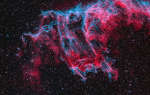 A Spectre in the Eastern Veil
29.10.2014
Frightening forms and scary faces are a mark of the Halloween season. They also haunt this cosmic close-up of the eastern Veil Nebula. The Veil Nebula itself is a large supernova remnant, the expanding debris cloud from the death explosion of a massive star.
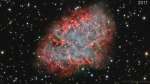 M1: The Incredible Expanding Crab
4.01.2018
The Crab Nebula is cataloged as M1, the first on Charles Messier's famous list of things which are not comets. In fact, the Crab is now known to be a supernova remnant, an expanding cloud of debris from the explosion of a massive star.
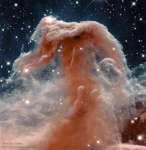 The Horsehead Nebula in Infrared from Hubble
21.09.2022
While drifting through the cosmos, a magnificent interstellar dust cloud became sculpted by stellar winds and radiation to assume a recognizable shape. Fittingly named the Horsehead Nebula, it is embedded in the vast and complex Orion Nebula (M42).
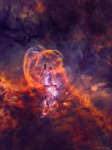 Star Forming Region NGC 3582 without Stars
30.07.2019
What's happening in the Statue of Liberty nebula? Bright stars and interesting molecules are forming and being liberated. The complex nebula resides in the star forming region called RCW 57, and besides the iconic monument, to some looks like a flying superhero or a weeping angel.
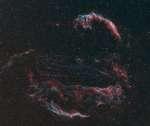 The Veil Nebula
16.09.2010
Delicate in appearance, these filaments of shocked, glowing gas, draped in planet Earth's sky toward the constellation of Cygnus, make up the Veil Nebula. The nebula is a large supernova remnant, an expanding cloud born of the death explosion of a massive star.
|
January February March April |
|||||||||||||||||||||||||||||||||||||||||||||||||