
|
You entered: star system
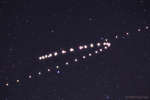 Retrograde Mars
27.10.2014
Why would Mars appear to move backwards? Most of the time, the apparent motion of Mars in Earth's sky is in one direction, slow but steady in front of the far distant stars. About every two years, however, the Earth passes Mars as they orbit around the Sun.
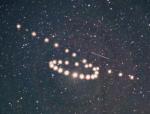 Retrograde Mars
16.12.2003
Why would Mars appear to move backwards? Most of the time, the apparent motion of Mars in Earth's sky is in one direction, slow but steady in front of the far distant stars. About every two years, however, the Earth passes Mars as they orbit around the Sun.
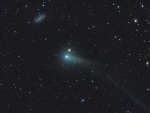 Comet PanSTARRS with Galaxy
6.06.2014
Sweeping slowly through northern skies, the comet PanSTARRS C/2012 K1 posed for this telescopic portrait on June 2nd in the constellation Ursa Major. Now in the inner solar system, the icy body from the Oort cloud sports two tails, a lighter broad dust tail and crooked ion tail extending below and right.
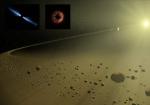 Debris Disks Surround Distant Suns
10.12.2004
In this dramatic artist's vision, debris along the outer reaches of a planet forming disk orbits in the glare of a distant sun. But inset are actual images of such disks around two nearby stars - AU Microscopii (top left; edge-on) and HD107146 (right: face-on) - as seen by the Hubble Space Telescope.
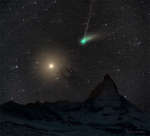 APOD: 2023 February 13 Б Comet ZTF and Mars
13.02.2023
No, Comet ZTF is not going to hit Mars. Nicknamed the Green Comet for its bright green coma, C/2022 E3 (ZTF) did, however, pass almost in front of the much-more distant planet a few days ago, very near in time to when the featured picture was taken.
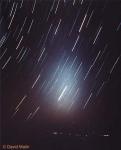 Zodiacal Light
26.08.1997
Sometimes the sky itself seems to glow. Usually, this means you are seeing a cloud reflecting sunlight or moonlight. If the glow appears as a faint band of light running across the whole sky, you are probably seeing the combined light from the billions of stars that compose our Milky Way Galaxy.
 Zodiacal Light
13.06.1999
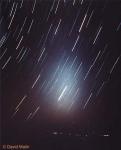
Sometimes the sky itself seems to glow. Usually, this means you are seeing a cloud reflecting sunlight or moonlight. If the glow appears as a faint band of light running across the whole sky, you are probably seeing the combined light from the billions of stars that compose our Milky Way Galaxy.
 Hen 1357: New Born Nebula
3.04.1998
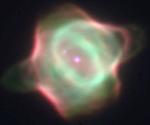
This Hubble Space Telescope picture shows Hen-1357, the youngest known planetary nebula. Graceful, gentle curves and symmetry suggest its popular name - The Stingray Nebula. Observations in the 1970s detected no nebular material, but this image from March 1996 clearly shows the Stingray's emerging bubbles and rings of shocked and ionized gas.
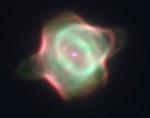 Hen 1357: New Born Nebula
6.10.2001
This Hubble Space Telescope snapshot shows Hen-1357, the youngest known planetary nebula. Graceful, gentle curves and symmetry suggest its popular name - The Stingray Nebula. Observations in the 1970s detected no nebular material, but this image from March 1996 clearly shows the Stingray's emerging bubbles and rings of shocked and ionized gas.
 Encke and the Tadpoles
27.10.2023
History's second known periodic comet is Comet Encke (2P/Encke). As it swings through the inner Solar System, Encke's orbit takes it from an aphelion, its greatest distance from the Sun, inside the orbit of Jupiter to a perihelion just inside the orbit of Mercury.
|
January February March April May June July August September October |
|||||||||||||||||||||||||||||||||||||||||||||||||