
|
You entered: supernova
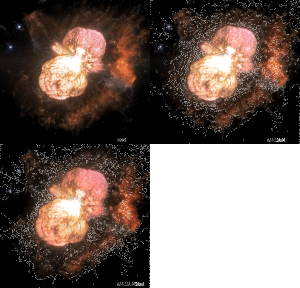 Eta Carinae and the Expanding Homunculus Nebula
1.12.2014
How did the Eta Carinae star system create this unusual expanding nebula? No one knows for sure. About 170 years ago, the southern star system Eta Carinae (Eta Car) mysteriously became the second brightest star system in the night sky. Twenty years later, after ejecting more mass than our Sun, Eta Car unexpectedly faded.
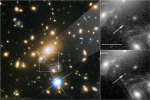 Fortuitous Flash Candidate for the Farthest Star Yet Seen
11.04.2018
Was this flash the farthest star yet seen? An unexpected flash of light noticed fortuitously on Hubble Space Telescope images may prove to be not only an unusual gravitational lensing event but also an image of a normal star 100 times farther away than any star previously imaged individually.
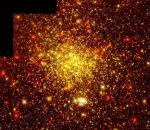 NGC1850: Star Cluster in the LMC
20.06.1997
NGC1850 is a large cluster of stars located a mere 166,000 light-years from Earth in our neighboring galaxy the Large Magellanic Cloud (LMC). The colors in this beautiful Hubble Space Telescope composite image of the cluster reveal different populations of stars.
 Carina Nebula Panorama from Hubble
23.06.2019
How do violent stars affect their surroundings? To help find out, astronomers created a 48-frame high-resolution, controlled-color panorama of the center of the Carina Nebula, one of the largest star forming regions on the night sky. The featured image, taken in 2007, was the most detailed image of the Carina Nebula yet taken.
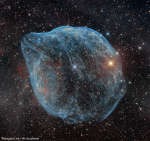 Sharpless 308: The Dolphin-Head Nebula
21.10.2021
Blown by fast winds from a hot, massive star, this cosmic bubble is huge. Cataloged as Sharpless 2-308 it lies some 5,000 light-years away toward the constellation of the Big Dog (Canis Major) and covers slightly more of the sky than a Full Moon.
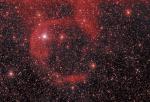 Alpha Cam: Runaway Star
24.11.2006
Runaway stars are massive stars traveling rapidly through interstellar space. Like a ship plowing through cosmic seas, runaway star Alpha Cam has produced this graceful arcing bow wave or bow shock - moving at over 60 kilometers per second and compressing the interstellar material in its path.
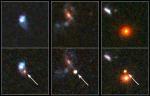 Rumors of a Strange Universe
27.02.2004
Only a few short years ago, when the APOD editors were in graduate school, the pervasive, cosmic Dark Energy was not even seriously discussed. Of course, it now appears that this strange energy dominates the cosmos (as well as lectures on cosmology) and provides a repulsive force accelerating the large scale expansion of the Universe.
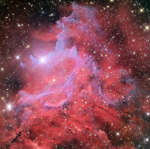 Flaming Star Nebula
1.12.2016
A runaway star lights the Flaming Star Nebula in this cosmic scene. Otherwise known as IC 405, the Flaming Star Nebula's billowing interstellar clouds of gas and dust lie about 1,500 light-years away toward the constellation of Auriga.
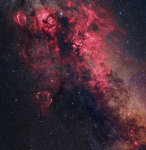 Cygnus Skyscape
25.07.2019
In brush strokes of interstellar dust and glowing hydrogen gas, this beautiful skyscape is painted across the plane of our Milky Way Galaxy near the northern end of the Great Rift and the constellation Cygnus the Swan.
 SGR 1900+14 : Magnetar
3.09.1998
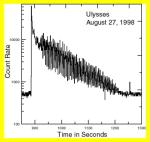
On August 27th an intense flash of X-rays and gamma-rays swept through our Solar System. Five spacecraft of the Third InterPlanetary gamma-ray burst Network, Ulysses, WIND, RXTE, NEAR, and BeppoSAX, recorded the high energy...
|
January February March April May June July August September October |
|||||||||||||||||||||||||||||||||||||||||||||||||