
|
You entered: Milky Way
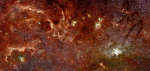 The Galactic Core in Infrared
7.01.2009
What's happening at the center of our Milky Way Galaxy? To help find out, the orbiting Hubble and Spitzer space telescopes have combined their efforts to survey the region in unprecedented detail in infrared light.
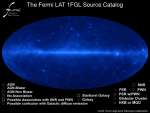 Fermi Catalogs the Gamma ray Sky
18.03.2010
What shines in the gamma-ray sky? The most complete answer yet to that question is offered by the Fermi Gamma-ray Space Telescope's first all-sky catalog. Fermi's sources of cosmic gamma-rays feature nature...
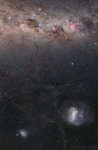 Galaxies and the South Celestial Pole
1.01.2021
The South Celestial Pole is easy to spot in star trail images of the southern sky. The extension of Earth's axis of rotation to the south, it's at the center of all the southern star trail arcs.
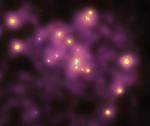 X For Andromeda
21.01.2000
A big beautiful spiral galaxy 2 million light-years away, Andromeda (M31) has long been touted as an analog to the Milky Way, a distant mirror of our own galaxy. The popular 1960s British sci-fi series, A For Andromeda, even postulated that it was home to another technological civilization that communicated with us.
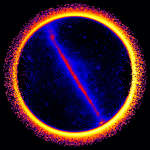 Gamma Ray Earth and Sky
6.12.2013
For an Earth-orbiting gamma-ray telescope, Earth is actually the brightest source of gamma-rays, the most energetic form of light. Gamma-rays from Earth are produced when high energy particles, cosmic rays from space, crash into the atmosphere.
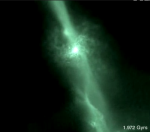 Simulation: A Disk Galaxy Forms
17.07.2012
How do galaxies like our Milky Way form? Since our universe moves too slowly to watch, faster-moving computer simulations are created to help find out. Green depicts (mostly) hydrogen gas in the above movie, while time is shown in billions of years since the Big Bang on the lower right.
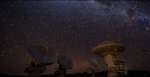 An ALMA Telescope Array Time Lapse
26.05.2014
It is the most expensive and complex ground-based astronomy project ever -- what will it see tonight? The Atacama Large Millimeter Array (ALMA) project consists of 66 dishes, many the size of a small house, situated in the high altitude Atacama Desert in Northern Chile.
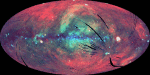 ROSAT Explores The X-Ray Sky
8.10.1996
Launched in 1990, the orbiting ROSAT observatory explored the Universe by viewing the entire sky in x-rays - photons with about 1,000 times more energy than visible light. This ROSAT survey produced the sharpest, most sensitive image of the x-ray sky to date.
 Fermi s Gamma Ray Sky
21.03.2009
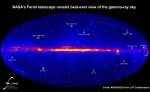
Scanning the entire sky in gamma-rays, photons with over 50 million times the energy of visible light, the Fermi mission's Large Area Telescope (LAT) explores the high-energy universe. This all-sky map constructed from...
 ROSAT Explores The X-Ray Sky
19.08.2000
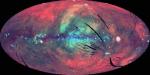
Launched in 1990, the orbiting ROSAT observatory explored the Universe by viewing the entire sky in x-rays -- photons with about 1,000 times more energy than visible light. This ROSAT survey produced the sharpest, most sensitive image of the x-ray sky to date.
|
January February March April May June July August September October |
|||||||||||||||||||||||||||||||||||||||||||||||||