
|
You entered: cluster
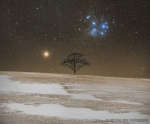 Mars and the Pleiades Beyond Vinegar Hill
6.04.2021
Is this just a lonely tree on an empty hill? To start, perhaps, but look beyond. There, a busy universe may wait to be discovered. First, physically, to the left of the tree, is the planet Mars.
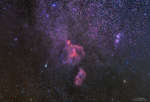 Comet Heart and Soul
23.08.2018
The greenish coma of comet 21P/Giacobini-Zinner stands out at the left of this telephoto skyscape spanning over 10 degrees toward the northern constellations Cassiopeia and Perseus. Captured on August 17, the periodic comet is the known parent body of the upcoming Draconid meteor shower.
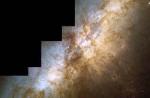 M82 After the Crash
12.03.2001
When did the Cigar Galaxy light up? Evidence indicates how M82, the Cigar Galaxy, became so bright and peculiar: it collided with neighboring galaxy M81. Astronomers become detectives, however, when trying to figure out when this collision occurred.
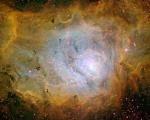 The Lagoon Nebula in Three Colors
20.08.2001
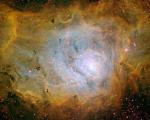
The bright Lagoon Nebula is home to a diverse array of astronomical objects. Particularly interesting sources include a bright open cluster of stars and several energetic star-forming regions. When viewed by eye, cluster light...
 The Lagoon Nebula in Three Colors
6.10.2002
The bright Lagoon Nebula is home to a diverse array of astronomical objects. Particularly interesting sources include a bright open cluster of stars and several energetic star-forming regions. When viewed by eye, cluster light...
 Seven Sisters Versus California
18.06.1996
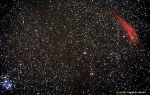
In the lower left corner, dressed in blue, is the Pleiades. Also known as the Seven Sisters and M45, the Pleiades is one of the brightest and most easily visible open clusters on the sky. The Pleiades contains over 3000 stars, is about 400 light years away, and only 13 light years across.
 Horizon to Horizon
21.12.2007
Scroll right and journey from horizon to horizon as your gaze sweeps through the zenith in the night sky over Beg-Meil, France. Recorded on December 13th, the entertaining panorama (image key) covers 210 degrees in 21 separate exposures, beginning on the beach with bright star Sirius rising in the southeast.
 Coronet in the Southern Crown
21.09.2007
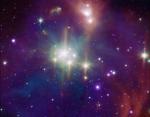
X-rays from young stars and infrared light from stars and cosmic dust are combined in this false color image of a star-forming region in Corona Australis, the Southern Crown. The small star grouping is fittingly known as the Coronet Cluster.
 NGC 1316: After Galaxies Collide
2.09.2008
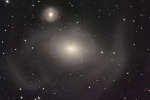
Astronomers turn detectives when trying to figure out the cause of startling sights like NGC 1316. Their investigation indicates that NGC 1316 is an enormous elliptical galaxy that started, about 100 million years ago, to devour a smaller spiral galaxy neighbor, NGC 1317, just above it.
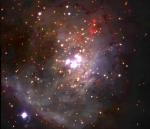 Free Floating Planets In Orion
31.03.2000
This false-colour image of the young Trapezium star cluster in the Orion Nebula was made with an infrared camera at wavelengths about twice as long as visible light. The infrared data are part...
|
January February March April May June July August September October |
|||||||||||||||||||||||||||||||||||||||||||||||||