
|
You entered: crater
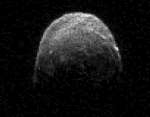 Asteroid 2005 YU55 Passes the Earth
9.11.2011
Asteroid 2005 YU55 passed by the Earth yesterday, posing no danger. The space rock, estimated to be about 400 meters across, coasted by just inside the orbit of Earth's Moon. Although the passing...
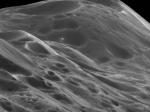 4000 Kilometers Above Saturns Iapetus
19.09.2007
What does the surface of Saturn's mysterious moon Iapetus look like? To help find out, the robotic Cassini spacecraft now orbiting Saturn was sent soaring last week just 2,000 kilometers from the unique equatorial ridge of the unusual walnut-shaped two-toned moon.
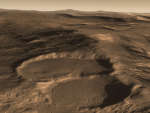 Radar Indicates Buried Glaciers on Mars
24.11.2008
What created this unusual terrain on Mars? The floors of several mid-latitude craters in Hellas Basin on Mars appear unusually grooved, flat, and shallow. New radar images from the Mars Reconnaissance Orbiter bolster an exciting hypothesis: huge glaciers of buried ice.
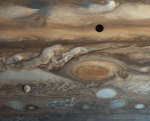 Europa and Jupiter from Voyager 1
5.09.2017
What are those spots on Jupiter? Largest and furthest, just right of center, is the Great Red Spot -- a huge storm system that has been raging on Jupiter possibly since Giovanni Cassini's likely notation of it 352 years ago. It is not yet known why this Great Spot is red.
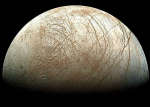 Gibbous Europa
15.12.2013
Although the phase of this moon might appear familiar, the moon itself might not. In fact, this gibbous phase shows part of Jupiter's moon Europa. The robot spacecraft Galileo captured this image mosaic during its mission orbiting Jupiter from 1995 - 2003.
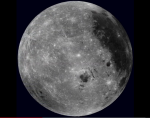 Rotating Moon from LRO
19.07.2020
No one, presently, sees the Moon rotate like this. That's because the Earth's moon is tidally locked to the Earth, showing us only one side. Given modern digital technology, however, combined with many detailed images returned by the Lunar Reconnaissance Orbiter (LRO), a high resolution virtual Moon rotation movie has been composed.
 Hubble Telescope Maps Pluto
11.03.1996
No spacecraft from Earth has yet explored Pluto but astronomers have found ways of mapping its surface. A stunning map of this distant, diminutive planet, the first based on direct images, was revealed late last week in a Hubble Space Telescope press release.
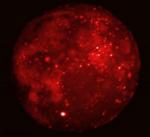 Eclipsed Moon in Infrared
8.11.2003
The total lunar eclipse of September 1996 disappointed many observers in North America who were cursed with cloudy skies. However, the Midcourse Space Experiment (MSX) satellite had a spectacular view from Earth orbit and SPIRIT III, an on board infrared telescope, was used to repeatedly image the moon during the eclipse.
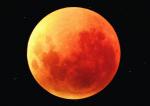 Lingering Lunar Eclipse
26.07.2000
As the Moon passed almost directly through the center of Earth's shadow on July 16th, sky gazers in the Pacific hemisphere were graced by a lingering lunar eclipse. The total phase lasted 1 hour and 47 minutes, the longest since 1859. A longer total lunar eclipse won't occur until the year 3000.
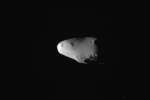 An Unusually Smooth Surface on Saturns Calypso
17.02.2010
Why is this moon of Saturn so smooth? This past weekend, humanity's Saturn-orbiting Cassini spacecraft passed as close to Saturn's small moon Calypso as it ever has, and imaged the small moon in unprecedented detail. Pictured above is an early return, raw, unprocessed image of the 20-km long irregularly shaped moon.
|
January February March April May June July August September October |
|||||||||||||||||||||||||||||||||||||||||||||||||