
|
You entered: hot star
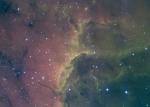 Pelican Nebula Ionization Front
3.07.2000
The Pelican Nebula is slowly being transformed. IC 5070, the official designation, is divided from the larger North America Nebula by a molecular cloud filled with dark dust. The Pelican, however, receives much study because it is a particularly active mix of star formation and evolving gas clouds.
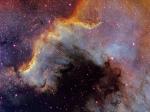 The Cygnus Wall of Star Formation
21.06.2005
The North America Nebula in the sky can do what North Americans on Earth cannot -- form stars. Specifically, in analogy to the Earth-confined continent, the bright part that appears as Central America and Mexico is actually a hot bed of gas, dust, and newly formed stars known as the Cygnus Wall.
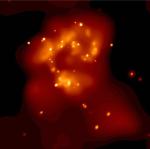 X-Rays From Antennae Galaxies
18.08.2000
A bevy of black holes and neutron stars shine as bright, point-like sources against bubbles of million degree gas in this false-color x-ray image from the orbiting Chandra Observatory. The striking picture shows...
 A Galactic Mushroom Cloud
3.02.1999
Part of our Galaxy is exploding. Recent radio observations show new details of hot gas expanding rapidly from an energetic star-forming region in our Galactic disk out into our Galaxy's halo. The combined power of at least hundreds of supernovae is needed to drive this tremendous expansion.
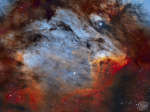 The Pelican Nebula in Gas, Dust, and Stars
25.09.2019
The Pelican Nebula is slowly being transformed. IC 5070, the official designation, is divided from the larger North America Nebula by a molecular cloud filled with dark dust. The Pelican, however, receives much study because it is a particularly active mix of star formation and evolving gas clouds.
 APOD: 2023 August 7 Б The Pelican Nebula in Gas, Dust, and Stars
7.08.2023
The Pelican Nebula is slowly being transformed. IC 5070 (the official designation) is divided from the larger North America Nebula by a molecular cloud filled with dark dust. The Pelican, however, receives much study because it is a particularly active mix of star formation and evolving gas clouds.
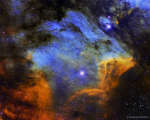 The Pelican Nebula in Gas Dust and Stars
17.11.2015
The Pelican Nebula is slowly being transformed. IC 5070, the official designation, is divided from the larger North America Nebula by a molecular cloud filled with dark dust. The Pelican, however, receives much study because it is a particularly active mix of star formation and evolving gas clouds.
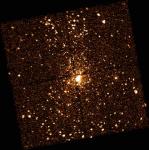 X-Ray Stars Of Orion
4.02.2000
The stars of Orion shine brightly in northern winter skies where the constellation harbors the closest large stellar nursery, the Great Nebula of Orion, a mere 1500 light-years away. In fact, the apparently bright...
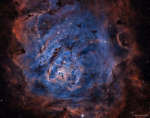 The Lagoon Nebula in Hydrogen Sulfur and Oxygen
5.01.2016
The majestic Lagoon Nebula is filled with hot gas and the home for many young stars. Spanning 100 light years across while lying only about 5000 light years distant, the Lagoon Nebula is so big and bright that it can be seen without a telescope toward the constellation of the Archer (Sagittarius).
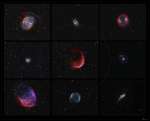 Planetary Nebula Project
18.02.2011
Cast off by dying sunlike stars, planetary nebulae are a brief but glorious final phase of stellar evolution. The gaseous shrouds are ionized by an extremely hot central source, the shrinking core of a star running out of fuel for nuclear fusion.
|
January February March April May June July |
|||||||||||||||||||||||||||||||||||||||||||||||||