
|
You entered: wind
GB-finalLeshin1024.preview.jpg) The Elephant s Trunk Nebula in Cepheus
The Elephant s Trunk Nebula in Cepheus
19.01.2017
Like an illustration in a galactic Just So Story, the Elephant's Trunk Nebula winds through the emission nebula and young star cluster complex IC 1396, in the high and far off constellation of Cepheus. Also known as vdB 142, the cosmic elephant's trunk is over 20 light-years long.
 Melotte 15 inthe Heart
10.02.2017
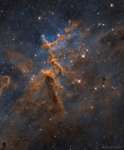
Cosmic clouds form fantastic shapes in the central regions of emission nebula IC 1805. The clouds are sculpted by stellar winds and radiation from massive hot stars in the nebula's newborn star cluster, Melotte 15.
 APOD: 2023 November 20 Б The Horsehead Nebula
20.11.2023
Sculpted by stellar winds and radiation, a magnificent interstellar dust cloud by chance has assumed this recognizable shape. Fittingly named the Horsehead Nebula, it is some 1,500 light-years distant, embedded in the vast Orion cloud complex.
 APOD: 2025 June 17 Б Rosette Nebula Deep Field
17.06.2025
Can you find the Rosette Nebula? The red flowery-looking nebula just above the image center may seem a good choice, but that's not it. The famous Rosette Nebula is really located on the lower right, here colored blue and white, and connected to the other nebulas by gold-colored filaments.
 Portrait of NGC 1055
27.11.2025
Big, beautiful spiral galaxy NGC 1055 is a dominant member of a small galaxy group a mere 60 million light-years away toward the aquatically intimidating constellation Cetus. Seen edge-on, the island universe spans over 100,000 light-years, a little larger than our own Milky Way galaxy.
 Unusual Rocks in Death Valley
10.04.2002
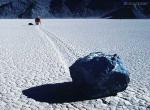
How did those big rocks end up on that strange terrain? One of the more unusual places here on Earth occurs inside Death Valley, California, USA. There a dried lakebed named Racetrack Playa exists that is almost perfectly flat, with the odd exception of some very large stones, one of which is pictured above.
 Inside the Eagle Nebula
24.10.2004
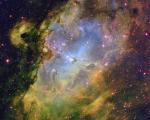
From afar, the whole thing looks like an Eagle. A closer look at the Eagle Nebula, however, shows the bright region is actually a window into the center of a larger dark shell of dust. Through this window, a brightly-lit workshop appears where a whole open cluster of stars is being formed.
 APOD: 2007 February 20- White Ridges on Mars
20.02.2007
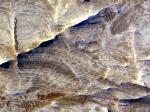
What created these white ridges on Mars? The images showing the white ridges, including some of the highest resolution images ever taken from Martian orbit, were recorded last year by the Mars Reconnaissance Orbiter (MRO).
 The Seahorse of the Large Magellanic Cloud
23.03.2009
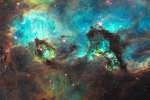
To some it may look to some like a big space monster, but it is more big than monster. To others it may look like a grazing seahorse, but the dark object toward the image right is actually an inanimate pillar of smoky dust about 20 light years long.
 The Milky Way Over the Badlands
18.08.2009
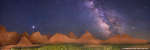
Why take a picture of just the Badlands when you can take one that also shows the spectacular sky above it? Just such a picture, actually a digital stitched panorama of four images, was taken in late June near midnight, looking southwest.
|
January February March April May June July August September October |
|||||||||||||||||||||||||||||||||||||||||||||||||