
|
You entered: Milky Way
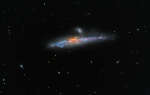 NGC 4631: The Whale Galaxy
3.06.2016
NGC 4631 is a big beautiful spiral galaxy. Seen edge-on, it lies only 25 million light-years away in the well-trained northern constellation Canes Venatici. The galaxy's slightly distorted wedge shape suggests to some a cosmic herring and to others its popular moniker, The Whale Galaxy.
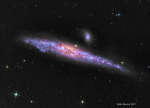 NGC 4631: The Whale Galaxy
6.10.2022
NGC 4631 is a big beautiful spiral galaxy. Seen edge-on, it lies only 25 million light-years away in the well-trained northern constellation Canes Venatici. The galaxy's slightly distorted wedge shape suggests to some a cosmic herring and to others its popular moniker, The Whale Galaxy.
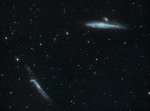 The Whale and the Hockey Stick
21.08.2009
NGC 4631 is a big beautiful spiral galaxy seen edge-on (top right) only 25 million light-years away towards the small northern constellation Canes Venatici. This galaxy's slightly distorted wedge shape suggests to some a cosmic herring and to others the popular moniker of The Whale Galaxy.
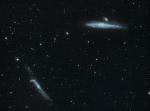 The Whale and the Hockey Stick
12.10.2007
NGC 4631 is a big beautiful spiral galaxy seen edge-on (top right) only 25 million light-years away towards the small northern constellation Canes Venatici. This galaxy's slightly distorted wedge shape suggests to some a cosmic herring and to others the popular moniker of The Whale Galaxy.
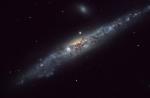 NGC 4631: The Whale Galaxy
29.03.2002
NGC 4631 is a big beautiful spiral galaxy seen edge-on only 25 million light-years away towards the small northern constellation Canes Venatici. This galaxy's slightly distorted wedge shape suggests to some a cosmic herring and to others the popular moniker of The Whale Galaxy.
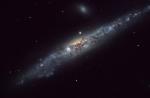 NGC 4631: The Whale Galaxy
23.01.2004
NGC 4631 is a big beautiful spiral galaxy seen edge-on only 25 million light-years away towards the small northern constellation Canes Venatici. This galaxy's slightly distorted wedge shape suggests to some a cosmic herring and to others the popular moniker of The Whale Galaxy.
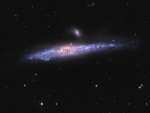 The Whale Galaxy
2.05.2009
NGC 4631 is a big beautiful spiral galaxy. Seen edge-on, it lies only 25 million light-years away in the well-trained northern constellation Canes Venatici. The galaxy's slightly distorted wedge shape suggests to some a cosmic herring and to others its popular moniker, The Whale Galaxy.
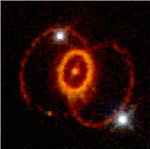 Supernova 1987a Aftermath
21.06.1995
In 1987 a star in one of the Milky Way's satellite galaxies exploded. In 1994 the Hubble Space Telescope, in orbit around the earth, took a very detailed picture of the remnants of this explosion. This picture, above, showed unusual and unexpected rings, and astronomers are not sure how they formed.
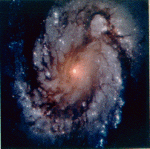 Spiral Galaxy M100
26.06.1995
The M100 galaxy is a large spiral galaxy similar to our own Milky Way, containing over 100 billion stars. It is over 150 million light years away, so the light we see left when dinosaurs roamed the Earth.
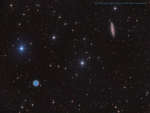 The Owl and the Galaxy
2.04.2015
The Owl and the Galaxy sail these skies With blue and yellow star. They go together beneath the Big Dipper, If you wonder where they are. The Galaxy's light shines through the night, Ten millions of light-years away. But never fear the Owl is near, Inside the Milky Way.
|
January February March April May June July August September October |
|||||||||||||||||||||||||||||||||||||||||||||||||