
|
You entered: Solar System
 Look West for a NEAT Comet
7.05.2004
On May 5th, while scanning western skies after sunset, astronomer Jimmy Westlake was glad to spot a visitor from the outer solar system, Comet NEAT, with his own eyes. Taken with a normal lens...
 Tails of Comet Garradd
20.10.2011
A good target for binoculars and small telescopes, Comet Garradd (C/2009 P1) now shines in planet Earth's evening skies, a steady performer but just below naked-eye visibility. Telescopic images like this composite from...
 A Zodiacal Sky over Horseshoe Bend
21.05.2017
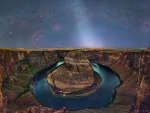
What's causing the unusual ray of white light extending upward from the central horizon? Dust orbiting the Sun. At certain times of the year, a band of sun-reflecting dust from the inner Solar System rises prominently before sunrise and is called zodiacal light.
 Comet ATLAS Breaks Up
15.04.2020
Cruising through the inner solar system, Comet ATLAS C2019/Y4 has apparently fragmented. Multiple separate condensations within its diffuse coma are visible in this telescopic close-up from April 12, composed of frames tracking the comet's motion against trailing background stars.
 APOD: 2023 May 24 Б Observatory Aligned with Moon Occulting Jupiter
23.05.2023
Sometimes we witness the Moon moving directly in front of -- called occulting -- one of the planets in our Solar System. Earlier this month that planet was Jupiter. Captured here was the moment when Jupiter re-appeared from behind the surface of our Moon.
 Phobos: Moon over Mars
21.03.2024
A tiny moon with a scary name, Phobos emerges from behind the Red Planet in this timelapse sequence from the Earth-orbiting Hubble Space Telescope. Over 22 minutes the 13 separate exposures were captured near the 2016 closest approach of Mars to planet Earth. Martians have to look to the west to watch Phobos rise, though.
 APOD: 2026 February 1 Б Galle: Happy Face Crater on Mars
31.01.2026
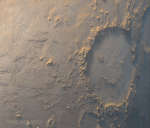
Mars has put on a happy face. The Martian crater Galle is famous because it has internal markings that make it look like a face that is both smiling and winking. These markings were originally discovered in the 1970s in pictures taken by the Viking Orbiter.
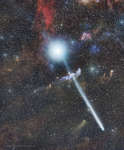 APOD: 2026 May 8 Б Comet R3 PanSTARRS Before Rigel
7.05.2026
Which way is Comet R3 PanSTARRS going? Not towards the star at the top of the image, because that is Rigel, which, being far in the background, is unrelated to the comet. Not through...
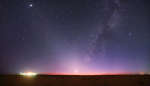 Skylights Over Libya
27.12.2010
Sometimes the sky itself seems to glow. Usually, this means you are seeing a cloud reflecting sunlight or moonlight. If the glow appears as a faint band of light running across the whole sky, you are probably seeing the combined light from the billions of stars that compose our Milky Way Galaxy.
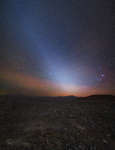 Zodiacal Light before Dawn
11.09.2014
You might not guess it, but sunrise was still hours away when this nightscape was taken, a view along the eastern horizon from a remote location in Chile's Atacama desert. Stretching high into...
|
January February March April May June July August |
||||||||||||||||||||||||||||||||||||||||||||||||||||||||