
|
You entered: galaxy center
 A Quasar Portrait Gallery
25.11.1996
QUASARs (QUASi-stellAR objects) lie near the edge of the observable Universe. Discovered in 1963, astronomers were astounded - to be visible at such extreme distances of billions of light-years they must emit prodigious amounts of energy. Where does the energy come from?
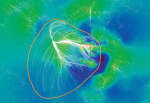 Laniakea: Our Home Supercluster of Galaxies
10.09.2014
It is not only one of the largest structures known -- it is our home. The just-identified Laniakea Supercluster of galaxies contains thousands of galaxies that includes our Milky Way Galaxy, the Local Group of galaxies, and the entire nearby Virgo Cluster of Galaxies.
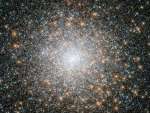 Globular Cluster M15 from Hubble
19.11.2013
Stars, like bees, swarm around the center of bright globular cluster M15. This ball of over 100,000 stars is a relic from the early years of our Galaxy, and continues to orbit the Milky Way's center.
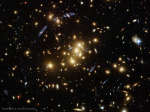 Giant Cluster Bends Breaks Images
23.08.2015
What are those strange blue objects? Many of the brightest blue images are of a single, unusual, beaded, blue, ring-like galaxy which just happens to line-up behind a giant cluster of galaxies. Cluster galaxies here typically appear yellow and -- together with the cluster's dark matter -- act as a gravitational lens.
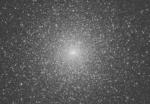 Globular Cluster M15
10.12.2001
Stars, like bees, swarm around the center of bright globular cluster M15. This ball of over 100,000 stars is a relic from the early years of our Galaxy, and continues to orbit the Milky Way's center.
 APOD: 2025 November 26 Б Globular Cluster M15 Deep Field
26.11.2025
Stars, like bees, swarm around the center of bright globular cluster M15. The central ball of over 100,000 stars is a relic from the early years of our Galaxy, and continues to orbit the Milky Way's center.
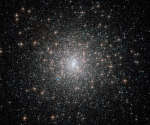 Globular Cluster M15 from Hubble
3.05.2011
Stars, like bees, swarm around the center of bright globular cluster M15. This ball of over 100,000 stars is a relic from the early years of our Galaxy, and continues to orbit the Milky Way's center.
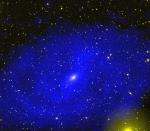 Ghost Galaxy NGC 2915
15.07.1998
How do you find a nearly invisible galaxy? Pictured above is the blue compact dwarf (BCD) galaxy NGC 2915. In visible light, shown above in yellow, this galaxy appears to be a normal dwarf galaxy, as indicated by the yellow smudge in the image center.
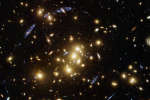 Giant Cluster Bends, Breaks Images
23.08.2009
What are those strange blue objects? Many of the brightest blue images are of a single, unusual, beaded, blue, ring-like galaxy which just happens to line-up behind a giant cluster of galaxies. Cluster galaxies here typically appear yellow and -- together with the cluster's dark matter -- act as a gravitational lens.
 APOD: 2025 August 20 Б Perseid Meteors from Durdle Door
20.08.2025
What are those curved arcs in the sky? Meteors -- specifically, meteors from this year's Perseid meteor shower. Over the past few weeks, after the sky darkened, many images of Perseid meteors were captured separately and merged into a single frame, taken earlier.
|
January February March April May June July August |
||||||||||||||||||||||||||||||||||||||||||||||||||||||||