
|
You entered: Auriga
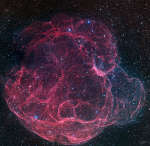 Simeis 147: Supernova Remnant
21.11.2019
It's easy to get lost following the intricate looping filaments in this detailed image of supernova remnant Simeis 147. Also cataloged as Sharpless 2-240 it goes by the popular nickname, the Spaghetti Nebula.
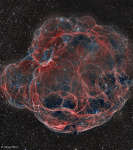 Simeis 147: Supernova Remnant
10.12.2020
It's easy to get lost following the intricate looping filaments in this detailed image of supernova remnant Simeis 147. Also cataloged as Sharpless 2-240 it goes by the popular nickname, the Spaghetti Nebula.
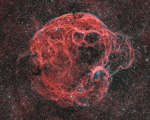 Supernova Remnant Simeis 147
13.01.2022
It's easy to get lost following the intricate, looping, twisting filaments in this detailed image of supernova remnant Simeis 147. Also cataloged as Sharpless 2-240 it goes by the popular nickname, the Spaghetti Nebula.
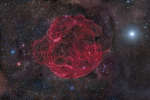 Simeis 147: Supernova Remnant
9.10.2012
It's easy to get lost following the intricate filaments in this detailed mosaic image of faint supernova remnant Simeis 147 (S147). Also cataloged as Sh2-240, it covers nearly 3 degrees or 6 full moons on the sky. That's about 150 light-years at the stellar debris cloud's estimated distance of 3,000 light-years.
 ZTF meets ATLAS
10.02.2023
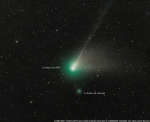
Fading as it races across planet Earth's northern skies comet C/2022 E3 (ZTF) shares this telescopic frame with comet C/2022 U2 (ATLAS). Captured on the night of February 6 from a garden observatory in Germany's Bavarian Forest, the starry field of view toward the constellation Auriga spans about 2.5 degrees.
 The Ghosts of Five Supernovas
24.09.2026
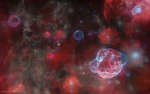
The ghosts of five supernovas haunt this extraordinary image. It was acquired at Oukaцmeden Observatory in Morocco with approximately 200 hours of observations and shows a large patch of the sky, equivalent to the area of one thousand full moons tiled together, in the constellation of Auriga (the charioteer).
 The Mystery of the Fading Star
8.01.2010
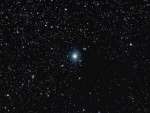
Every 27 years Epsilon Aurigae fades, remaining dim for roughly two years before growing bright again. Since the 19th century, astronomers have studied the mystery star, eventually arguing that Epsilon Aur, centered in this telescopic skyview, was actually undergoing a long eclipse by a dark companion object.
 GLAST Gamma Ray Sky Simulation
22.07.2000
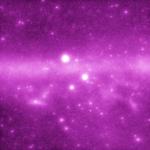
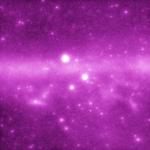
What shines in the gamma-ray sky? This simulated image models the intensities of gamma rays with over 40 million times the energy of visible light, and represents how the sky might appear to the Gamma-ray Large Area Space Telescope (GLAST) after its first year in orbit.
 GLAST Gamma Ray Sky Simulation
12.11.1998
This simulated image models the intensities of gamma rays with over 40 million times the energy of visible light, and represents how the sky might appear to the proposed Gamma-ray Large Area Space Telescope (GLAST) after its first year in orbit.
|
January February March April May June July August September October |
|||||||||||||||||||||||||||||||||||||||||||||||||