
|
You entered: Crab Nebula
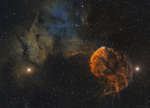 Sharpless 249 and the Jellyfish Nebula
7.03.2019
Normally faint and elusive, the Jellyfish Nebula is caught in this alluring telescopic field of view. The entire scene is a two panel mosaic constructed using narrowband image data, with emission from sulfur, hydrogen and oxygen atoms shown in red, green and blue hues.
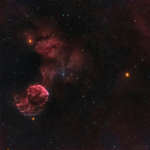 The Jellyfish and Mars
19.05.2021
Normally faint and elusive, the Jellyfish Nebula is caught in this alluring scene. In the telescopic field of view two bright yellowish stars, Mu and Eta Geminorum, stand just below and above the Jellyfish Nebula at the left. Cool red giants, they lie at the foot of the celestial twin.
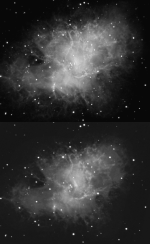 The Incredible Expanding Crab
27.12.2001
The Crab Nebula is cataloged as M1, the first on Charles Messier's famous list of things which are not comets. In fact, the Crab is now known to be a supernova remnant, an expanding cloud of debris from the explosion of a massive star.
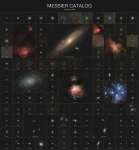 APOD: 2026 May 14 Б The Messier Catalog at Uniform Scale
14.05.2026
What are some of the most interesting astronomical objects you can see in the night sky? Armed with a good pair of binoculars or a small telescope, if you live in the Northern Hemisphere, you can look for the very popular objects in the Messier Catalog.
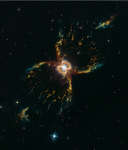 The Shape of the Southern Crab
24.04.2019
The symmetric, multi-legged appearance of the Southern Crab Nebula is certainly distinctive. About 7,000 light-years distant toward the southern sky constellation Centaurus, its glowing nested hourglass shapes are produced by the remarkable symbiotic binary star system at its center.
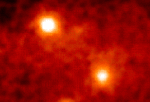 Gamma Ray Crab, Geminga
24.06.1995
What if you could "see" in gamma-rays? If you could, these two spinning neutron stars or pulsars would be among the brightest objects in the sky. This computer processed image shows the Crab Nebula pulsar (below and right of center) and the Geminga pulsar (above and left of center) in the "light" of gamma-rays.
 Messier 2
4.04.2019
After the Crab Nebula, M1, this giant star cluster is the second entry in 18th century astronomer Charles Messier's famous list of things with are not comets. M2 is one of the largest globular star clusters now known to roam the halo of our Milky Way galaxy.
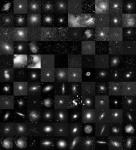 Messier Marathon
18.03.1999
Gripped by an astronomical spring fever, this week many amateur stargazers embark on a Messier Marathon. The Vernal Equinox occurs Saturday, March 20, marking the first day of Spring for the Northern Hemisphere.
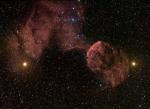 Elusive Jellyfish Nebula
8.04.2004
Normally faint and elusive, the Jellyfish Nebula is caught in the net of this spectacular wide-field telescopic view. Flanked by two yellow-tinted stars at the foot of a celestial twin - Mu and Eta Geminorum - the Jellyfish Nebula is the brighter arcing ridge of emission with dangling tentacles just right of center.
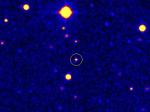 Mystery Object Explained
28.09.1999
Explorers often discover the unexpected. Such was the case when the Second Palomar Observatory Sky Survey chanced upon the unusual object circled in the above photograph. The so-called mystery object appeared star-like but displayed colors unlike most stars or quasars.
|
January February March April May June July August September October |
|||||||||||||||||||||||||||||||||||||||||||||||||