
|
You entered: Earth orbit
 APOD: 2025 August 12 Б Perseids from Perseus
12.08.2025
Where are all of these meteors coming from? In terms of direction on the sky, the pointed answer is the constellation of Perseus. That is why the meteor shower that peaks tonight is known as the Perseids -- the meteors all appear to come from a radiant toward Perseus.
 A View from the Zone
7.03.2014
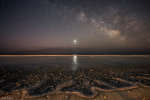
Brilliant Venus and the central Milky Way rise in the early morning hours of March 1 in this sea and skyscape. The scene looks out from a beach at Sea Isle City, New Jersey, USA, planet Earth.
 Noctilucent NEOWISE
9.07.2020
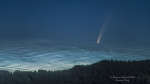
These silvery blue waves washing over a tree-lined horizon in the eastern French Alps are noctilucent clouds. From high in planet Earth's mesosphere, they reflect sunlight in this predawn skyscape taken on July 8. This summer, the night-shining clouds are not new to the northern high-latitudes. Comet NEOWISE is though.
 Lyrid Meteors from the Constellation Lyra
12.05.2020
Where are all of these meteors coming from? In terms of direction on the sky, the pointed answer is the constellation of Small Harp (Lyra). That is why the famous meteor shower that peaks every April is known as the Lyrids -- the meteors all appear to came from a radiant toward Lyra.
 Z is for Mars
22.04.2006
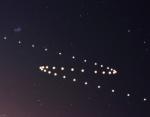
This composite of images spaced about a week apart - from late July 2005 (bottom right) through February 2006 (top left) - traces the retrograde motion of ruddy-colored Mars through planet Earth's night sky. On November 7th, 2005 the Red Planet was opposite the Sun in Earth's sky (at opposition).
 APOD: 2023 January 24 Б LHS 475 b: Earth Sized Exoplanet
24.01.2023
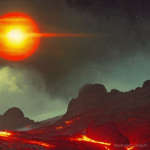
If you could stand on exoplanet LHS 475 b, what might you see? No one knows for sure but pictured here is an interesting guess made by an Earth-based artificial intelligence (AI) engine.
 Comet NEOWISE from the ISS
10.07.2020
Rounding the Sun on July 3rd and currently headed for the outer Solar System, Comet NEOWISE (C/2020 F3) has been growing brighter in the predawn skies of planet Earth. From low Earth orbit...
 Three Years of Saturn
7.04.2007
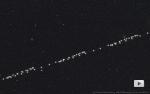
Using an image recorded just last month as a base, this composite illustration tracks the motion of bright Saturn as it wanders through planet Earth's night sky. Starting at the upper right, Saturn's position is shown about every two weeks beginning in August 2005 and projected through September 2008.
 Eros At Sunset
24.08.2000
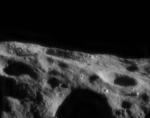
Gleaming in the rays of the setting sun, boulders litter the rugged surface of asteroid 433 Eros. The brightest boulder, at the edge of the large, shadowy crater near this picture's bottom center, is about 30 meters (100 feet) across.
 A Solar Prominence Erupts in STEREO
20.10.2009
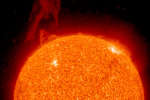
What does a solar prominence look like in three dimensions? To help find out, NASA launched the STEREO satellites to keep a steady eye on the Sun from two different vantage points. The STEREO...
|
January February March April May June July August September October |
|||||||||||||||||||||||||||||||||||||||||||||||||