
|
You entered: Great Red Spot
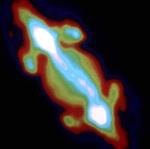 Radio Jupiter
9.10.2003
This view of gas giant Jupiter, made from data recorded at the Very Large Array radio observatory near Socorro, New Mexico, may not look too familiar. In fact, there is no sign of a bright, round planet striped with cloud bands, sporting a Great Red Spot.
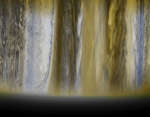 Jupiter's Clouds from New Horizons
23.10.2011
The New Horizons spacecraft took some stunning images of Jupiter on its way out to Pluto. Famous for its Great Red Spot, Jupiter is also known for its regular, equatorial cloud bands, visible through even modest sized telescopes.
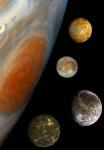 Jupiter And Family
18.11.2000
This composite image features classic portraits of members of one of the Solar System's most prominent families - Jupiter and its four large "Galilean" moons. Starting from the top the moons are Io, Europa, Ganymede, and Callisto. The top-to-bottom order is also the order of increasing distance from Jupiter.
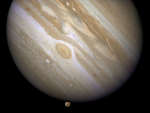 Jupiter Eclipsing Ganymede
6.01.2009
How hazy is Jupiter's upper atmosphere? To help find out, astronomers deployed the Hubble Space Telescope to watch Jupiter eclipse its moon Ganymede. Although Ganymede circles Jupiter once a week, it usually passes above or below the planet, so that a good eclipse occurs more rarely.
 Jupiter over 2 Hours and 30 Minutes
19.01.2024
Jupiter, our Solar System's ruling gas giant, is also the fastest spinning planet, rotating once in less than 10 hours. The gas giant doesn't rotate like a solid body though.
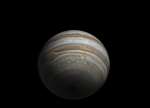 Approaching Jupiter
23.05.2017
What would it look like to approach Jupiter? To help answer this, a team of 91 amateur astrophotographers took over 1,000 pictures of Jupiter from the Earth with the resulting images aligned and digitally merged into the featured time-lapse video. Image taking began in 2014 December and lasted just over three months.
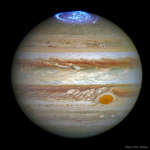 Aurorae on Jupiter
11.07.2016
Jupiter has aurorae. Like Earth, the magnetic field of the gas giant funnels charged particles released from the Sun onto the poles. As these particles strike the atmosphere, electrons are temporarily knocked away from existing gas molecules. Electric force attracts these electrons back. As the electrons recombine to remake neutral molecules, auroral light is emitted.
 APOD: 2023 June 13 Б Moons Across Jupiter
13.06.2023
Jupiter's moons circle Jupiter. The featured video depicts Europa and Io, two of Jupiter's largest moons, crossing in front of the grand planet's Great Red Spot, the largest known storm system in our Solar System.
 Jupiter s Clouds from New Horizons
15.10.2007
The New Horizons spacecraft took some stunning images of Jupiter earlier this year while on the way out to Pluto. Famous for its Great Red Spot, Jupiter is also known for its regular, equatorial cloud bands, visible through even modest sized telescopes.
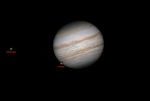 Jupiter Rotates as Moons Orbit
25.10.2022
Jupiter and its moons move like our Sun and its planets. Similarly, Jupiter spins while its moons circle around. JupiterБs rotation can be observed by tracking circulating dark belts and light zones. The Great Red Spot, the largest storm known, rotates to become visible after about 15 seconds in the 48-second time lapse video.
|
January February March April May June July August September October |
|||||||||||||||||||||||||||||||||||||||||||||||||