
|
You entered: coronal mass ejection
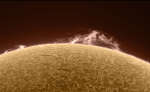 Reinvigorated Sun and Prominence
23.03.2010
Dramatic prominences can sometimes be seen looming just beyond the edge of the sun. Such was the case last week as a giant prominence, visible above on the right, highlighted a Sun showing increased activity as it comes off an unusually quiet Solar Minimum.
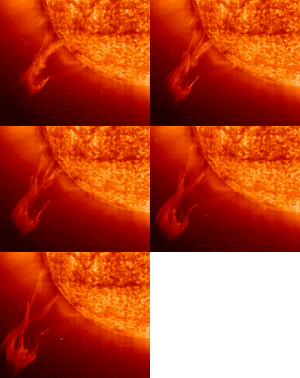 A Twisted Solar Eruptive Prominence
24.01.2015
Ten Earths could easily fit in the "claw" of this seemingly solar monster. The monster, actually a huge eruptive prominence, is seen moving out from our Sun in this condensed half-hour time-lapse sequence. This large prominence, though, is significant not only for its size, but its shape.
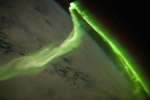 Above Aurora Australis
1.07.2010
On May 29, looking southward from a vantage point about 350 kilometers above the southern Indian Ocean, astronauts onboard the International Space Station watched this enormous, green ribbon shimmering below. Known as aurora australis...
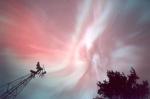 Red Auroral Corona
15.01.2002
Few auroras show this level of detail. This unusual display of an auroral corona occurred on Earth three days after an unusual solar event -- the fifth most powerful explosion yet recorded on the Sun. An X14-class solar flare on April 15 sent a tremendous Coronal Mass Ejection (CME) into the Solar System.
 Aurorae over Planet Earth
11.10.2012
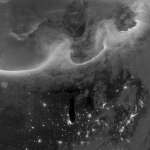
North America at night is easy to recognize in this view of our fair planet from orbit, acquired by the Suomi-NPP satellite on October 8. The spectacular waves of visible light emission rolling above the Canadian provinces of Quebec and Ontario in the upper half of the frame are the Aurora Borealis or northern lights.
 A Solar Prominence from SOHO
9.11.2005
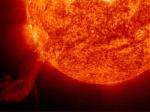
What happened to the Sun? Nothing very unusual: the strange-looking solar appendage on the lower left is actually just a spectacular looking version of a common solar prominence. A solar prominence is a cloud of solar gas held above the Sun's surface by the Sun's magnetic field.
 Sigmoids Predict Solar Eruptions
16.03.1999
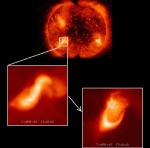
On the Sun, S marks the spot. Solar explosions have been discovered to explode preferentially from regions marked with this letter. The surface of the quiet Sun is a maze of hot gas and flowing magnetic fields. When two regions of high magnetic field strength approach each other, they typically pass uneventfully.
 The Sun Puffs
29.10.2006
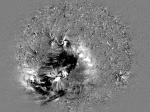
Our Earth endures bursts of particles from the Sun. On 1997 April 7, at 10 am (EDT), ground monitors of the SOHO spacecraft, which continually monitors the Sun, noticed a weak spot in the solar corona was buckling again, this time letting loose a large, explosive Coronal Mass Ejection (CME).
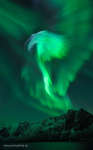 Eagle Aurora over Norway
23.10.2016
What's that in the sky? An aurora. A large coronal mass ejection occurred on our Sun five days before this 2012 image was taken, throwing a cloud of fast moving electrons, protons, and ions toward the Earth.
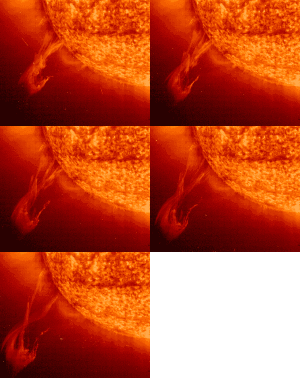 A Twisted Solar Eruptive Prominence
23.02.2003
A huge eruptive prominence is seen moving out from our Sun in this condensed half-hour time-lapse sequence. Ten Earths could easily fit in the "claw" of this seemingly solar monster. This large prominence, though, is significant not only for its size, but its shape.
|
January February March April May June July August September |
|||||||||||||||||||||||||||||||||||||||||||||||||