
|
You entered: emission nebula
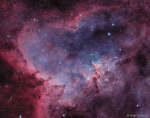 In the Heart of the Heart Nebula
13.02.2018
What's that inside the Heart Nebula? First, the large emission nebula dubbed IC 1805 looks, in whole, like a human heart. It's shape perhaps fitting of the Valentine's Day, this heart glows brightly in red light emitted by its most prominent element: hydrogen.
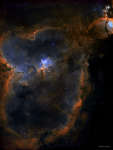 Bright from the Heart Nebula
26.10.2015
What's that inside the Heart Nebula? First, the large emission nebula dubbed IC 1805 looks, in whole, like a human heart. The nebula glows brightly in red light emitted by its most prominent element: hydrogen.
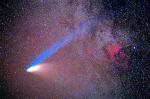 Hale Bopp and the North American Nebula
9.10.1997
Comet Hale-Bopp's recent encounter with the inner Solar System allowed many breath-taking pictures. Above, Comet Hale-Bopp was photographed on March 8th in the constellation of Cygnus. Visible on the right in red is the North American Nebula, a bright emission nebula observable from a dark location with binoculars.
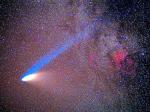 Comet Hale Bopp and the North America Nebula
3.10.2004
Comet Hale-Bopp's 1997 encounter with the inner Solar System allowed many breath-taking pictures. Above, Comet Hale-Bopp was photographed crossing the constellation of Cygnus, sporting spectacular yellow dust and blue ion tails. Visible on the right in red is the North America Nebula, a bright emission nebula observable from a dark location with binoculars.
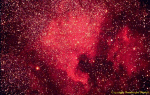 The North America Nebula
6.06.1996
Here's a familiar shape in an unfamiliar location! This emission nebula is famous partly because it resembles Earth's North American Continent. To the right of the North America Nebula is a less luminous Pelican Nebula. Let's be grateful that pelicans aren't really that large!
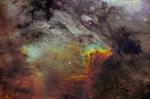 IC 5067: A Piece of the Pelican
19.10.2007
(xxxedit and linkxxx) The prominent ridge of emission featured in this dramatic skyscape is cataloged as IC 5067. Part of a larger emission nebula with a distinctive shape, popularly called The Pelican Nebula, the ridge spans about 10 light-years following the curve of the cosmic pelican's head and neck.
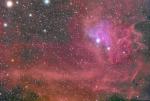 IC 405: The Flaming Star Nebula
23.11.2003
Rippling dust and gas lanes give the Flaming Star Nebula its name. The red and purple colors of the nebula are present in different regions and are created by different processes. The bright star...
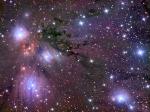 Stars, Dust and Nebula in NGC 2170
27.02.2007
When stars form, pandemonium reigns. A textbook case is the star forming region NGC 2170. Visible above are red glowing emission nebulas of hydrogen, blue reflection nebulas of dust, dark absorption nebulas of dust, and the stars that formed from them.
 APOD: 2023 December 13 Б Deep Field: The Heart Nebula
12.12.2023
What excites the Heart Nebula? First, the large emission nebula on the left, catalogued as IC 1805, looks somewhat like a human heart. The nebula glows brightly in red light emitted by its most prominent element, hydrogen, but this long-exposure image was also blended with light emitted by silicon (yellow) and oxygen (blue).
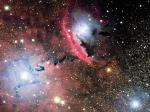 Stars, Dust and Nebula in NGC 6559
9.05.2005
When stars form, pandemonium reigns. A textbook case is the star forming region NGC 6559. Visible above are red glowing emission nebulas of hydrogen, blue reflection nebulas of dust, dark absorption nebulas of dust, and the stars that formed from them.
|
January February March April May June July August September October |
|||||||||||||||||||||||||||||||||||||||||||||||||