
|
You entered: galaxies
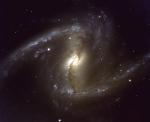 NGC 1365: A Nearby Barred Spiral Galaxy
24.06.1999
Many spiral galaxies have bars across their centers. Even our own Milky Way Galaxy is thought to have a bar, but perhaps not so prominent as the one in NGC 1365, shown above. The persistence and motion of the bar imply relatively massive spiral arms.
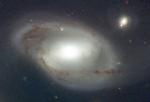 The Galaxy and the Quasar
7.10.2002
Is the galaxy in the center connected to the quasar on the upper right? Disagreements about systems like this have raged for decades and have been used to challenge the foundations of modern cosmology.
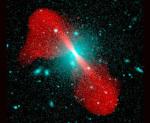 Jets from Radio Galaxy 3C296
26.02.2002
Jets of streaming plasma expelled by the central black hole of a massive elliptical galaxy likely light up this composite image of 3C296. The jets emanating from NGC 5532 and are nearly a million light years long. Exactly how the central black hole expels the infalling matter is still unknown.
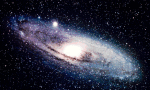 M31: The Andromeda Galaxy
9.10.1996
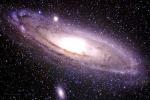
Andromeda is the nearest major galaxy to our own Milky Way Galaxy. Our Galaxy is thought to look much like Andromeda. Together these two galaxies dominate the Local Group of galaxies. The diffuse light from Andromeda is caused by the hundreds of billions of stars that compose it.
 M31: The Andromeda Galaxy
14.11.1999
Andromeda is the nearest major galaxy to our own Milky Way Galaxy. Our Galaxy is thought to look much like Andromeda. Together these two galaxies dominate the Local Group of galaxies. The diffuse light from Andromeda is caused by the hundreds of billions of stars that compose it.
 Starburst Galaxy M94
21.11.2002
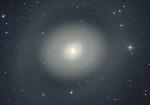
What could cause the center of M94 to be so bright? Spiral galaxy M94 has a ring of newly formed stars surrounding its nucleus, giving it not only an unusual appearance but also a strong interior glow.
 The 2MASS Galaxy Sky
26.06.2005
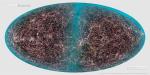
Are the nearest galaxies distributed randomly? A plot of over one million of the brightest "extended sources" detected by the Two Micron All Sky Survey (2MASS) shows that they are not. The vast majority of these infrared extended sources are galaxies.
 Neighboring Galaxy: The Large Magellanic Cloud
4.08.2001
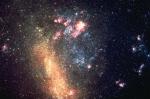
The brightest galaxy visible from our own Milky Way Galaxy is the Large Magellanic Cloud (LMC). Visible predominantly from Earth's Southern Hemisphere, the LMC is the second closest galaxy, neighbor to the Small Magellanic Cloud, and one of eleven known dwarf galaxies that orbit our Milky Way Galaxy.
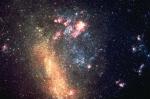 Neighboring Galaxy: The Large Magellanic Cloud
22.02.2000
The brightest galaxy visible from our own Milky Way Galaxy is the Large Magellanic Cloud (LMC). Visible predominantly from Earth's Southern Hemisphere, the LMC is the second closest galaxy, neighbor to the Small Magellanic Cloud, and one of eleven known dwarf galaxies that orbit our Milky Way Galaxy.
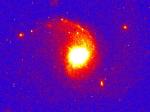 Quasar in an Elliptical Galaxy
9.04.1998
Where do quasars live? Quasars are the brightest objects in the universe, so bright they can be seen from across the universe. Observations continue to show that most quasars are surrounded by a relatively faint nebulous patch. Astronomers are trying to identify the nature of these patches.
|
January February March April May June July August September October |
|||||||||||||||||||||||||||||||||||||||||||||||||