
|
You entered: globular cluster
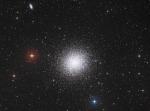 M13: The Great Globular Cluster in Hercules
15.11.2007
M13 is modestly recognized as the Great Globular Cluster in Hercules. A system of stars numbering in the hundreds of thousands, it is one of the brightest globular star clusters in the northern sky.
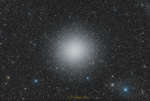 Globular Cluster Omega Centauri
11.07.2024
Globular star cluster Omega Centauri packs about 10 million stars much older than the Sun into a volume some 150 light-years in diameter. Also known as NGC 5139, at a distance...
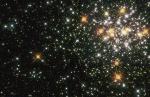 NGC 1818: A Young Globular Cluster
17.01.1999
Globular clusters once ruled the Milky Way. Back in the old days, back when our Galaxy first formed, perhaps thousands of globular clusters roamed our Galaxy. Today, there are perhaps 200 left. Many globular clusters were destroyed over the eons by repeated fateful encounters with each other or the Galactic center.
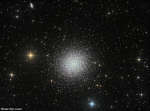 M13: The Great Globular Cluster in Hercules
4.08.2022
In 1716, English astronomer Edmond Halley noted, "This is but a little Patch, but it shows itself to the naked Eye, when the Sky is serene and the Moon absent." Of course...
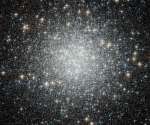 Blue Straggler Stars in Globular Cluster M53
9.04.2012
If our Sun were part of M53, the night sky would glow like a jewel box of bright stars. M53, also known as NGC 5024, is one of about 250 globular clusters that survive in our Galaxy.
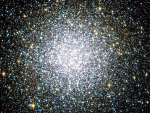 APOD: 2008 April 2- Globular Cluster M55 from CFHT
2.04.2008
The fifty-fifth entry in Charles Messier's catalog, M55 is a large and lovely globular cluster of around 100,000 stars. Only 20,000 light-years away in the constellation Sagittarius, M55 appears to earth-bound observers to be nearly 2/3 the size of the full moon.
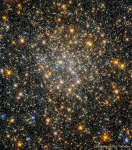 Palomar 6: Globular Star Cluster
19.10.2021
Where did this big ball of stars come from? Palomar 6 is one of about 200 globular clusters of stars that survive in our Milky Way Galaxy. These spherical star-balls are older than our Sun as well as older than most stars that orbit in our galaxy's disk.
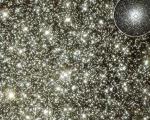 Unusual Flashes Toward Globular Cluster M22
3.07.2001
What is causing the unusual flashes behind globular cluster M22? This teaming ball of stars is the brightest globular cluster visible in Earth's northern hemisphere. M22, shown in full in the inset, spans about 50 light years away and lies 8500 light-years toward the constellation of Sagittarius.
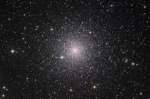 Globular Star Cluster NGC 6752
5.07.2013
Some 13,000 light-years away toward the southern constellation Pavo, the globular star cluster NGC 6752 roams the halo of our Milky Way galaxy. Over 10 billion years old, NGC 6752 follows clusters Omega Centauri and 47 Tucanae as the third brightest globular in planet Earth's night sky.
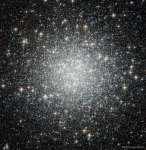 Blue Straggler Stars in Globular Cluster M53
7.02.2021
If our Sun were part of this star cluster, the night sky would glow like a jewel box of bright stars. This cluster, known as M53 and cataloged as NGC 5024, is one of about 250 globular clusters that survive in our Galaxy.
|
January February March April May June July August September |
|||||||||||||||||||||||||||||||||||||||||||||||||