
|
You entered: lunar limb
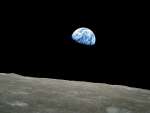 Earthrise
24.12.2008
Forty years ago, in December of 1968, the Apollo 8 crew flew from the Earth to the Moon and back again. Frank Borman, James Lovell, and William Anders were launched atop a Saturn V rocket on December 21, circled the Moon ten times in their command module, and returned to Earth on December 27.
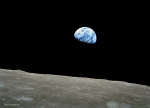 Earthrise
6.09.2015
What's that rising over the edge of the Moon? Earth. About 47 years ago, in December of 1968, the Apollo 8 crew flew from the Earth to the Moon and back again. Frank...
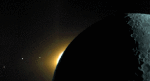 The Ecliptic Plane
14.10.2000
The Plane of the Ecliptic is well illustrated in this picture from the 1994 lunar prospecting Clementine spacecraft. Clementine's star tracker camera image reveals (from right to left) the Moon lit by Earthshine, the Sun's corona rising over the Moon's dark limb, and the planets Saturn, Mars, and Mercury.
 Earthrise
24.12.2005
In December of 1968, the Apollo 8 crew flew from the Earth to the Moon and back again. Frank Borman, James Lovell, and William Anders were launched atop a Saturn V rocket on December 21, circled the Moon ten times in their command module, and returned to Earth on December 27.
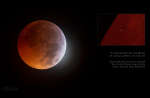 Moon Struck
25.01.2019
Craters produced by ancient impacts on the airless Moon have long been a familiar sight. But only since the 1990s have observers began to regularly record and study optical flashes on the lunar surface, likely explosions resulting from impacting meteoroids. Of course, the flashes are difficult to see against a bright, sunlit lunar surface.
 The Reappearance of Mars
11.09.2020
Mars reappears just beyond the Moon's dark limb in this stack of sharp video frames captured on September 6. Of course to reappear it had to disappear in the first place.
 Regulus Occulted
2.08.1999
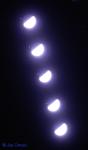
On May 21, viewed from the continental US, a star winked out as it passed behind the dark limb of the first-quarter Moon. The star, Regulus, is hotter than the sun, about 69 light-years distant, and shines in Earth's skies as the brightest star in the constellation Leo, the Lion.
 The Flash Spectrum of the Sun
12.03.2016
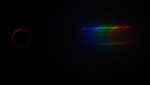
In a flash, the visible spectrum of the Sun changed from absorption to emission on March 9 during the total solar eclipse. That fleeting moment, at the beginning the total eclipse phase, is captured by telephoto lens and diffraction grating in this image from clearing skies over Ternate, Indonesia.
 Lingering Lunar Eclipse
26.07.2000
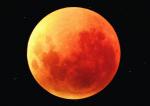
As the Moon passed almost directly through the center of Earth's shadow on July 16th, sky gazers in the Pacific hemisphere were graced by a lingering lunar eclipse. The total phase lasted 1 hour and 47 minutes, the longest since 1859. A longer total lunar eclipse won't occur until the year 3000.
 The Ecliptic Plane
21.09.1996
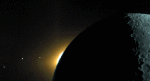
The Plane of the Ecliptic is illustrated in this Clementine star tracker camera image which reveals (from right to left) the Moon lit by Earthshine, the Sun's corona rising over the Moon's dark limb, and the planets Saturn, Mars, and Mercury.
|
January February March April May June July August September |
|||||||||||||||||||||||||||||||||||||||||||||||||