
|
You entered: nearest stars
 Encke and the Tadpoles
27.10.2023
History's second known periodic comet is Comet Encke (2P/Encke). As it swings through the inner Solar System, Encke's orbit takes it from an aphelion, its greatest distance from the Sun, inside the orbit of Jupiter to a perihelion just inside the orbit of Mercury.
 The Solar Neighborhood
25.02.1998
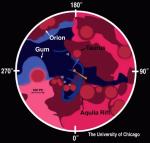
You are here. The orange dot in the above false-color drawing represents the current location of the Sun among local gas clouds in the spiral Milky Way Galaxy. These gas clouds are so thin that we usually see right through them. Nearly spherical bubbles surround regions of recent star formation.
 A February Moon Halo
11.02.2012
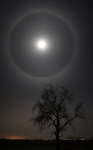
Lighting the night last Tuesday, February's Full Moon is sometimes called the Snow Moon. But the Moon was not quite full in this mosaicked skyscape recorded on February 2 south of Budapest, Hungary, and there was no snow either.
 Geminid Fireball over Mount Balang
16.12.2014
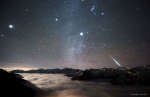
This was a sky to remember. While viewing the Geminids meteor shower a few days ago, a bright fireball was captured over Mt. Balang, China with particularly picturesque surroundings. In the foreground, a sea of light clouds slowly floated between dark mountain peaks.
 The Quintuplet Star Cluster
21.09.1999
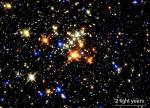
Bright clusters of stars form and disperse near the center of our Galaxy. Four million years ago the Quintuplet Cluster, pictured above, formed and is now slowly dispersing. The Quintuplet Cluster is located within 100 light-years of the Galactic center, and is home to the brightest star yet cataloged in our Galaxy: the Pistol Star.
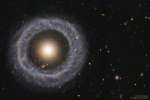 Hoags Object: A Nearly Perfect Ring Galaxy
27.11.2019
Is this one galaxy or two? This question came to light in 1950 when astronomer Arthur Hoag chanced upon this unusual extragalactic object. On the outside is a ring dominated by bright blue stars, while near the center lies a ball of much redder stars that are likely much older.
 APOD: 2024 February 18 Б Hoags Object: A Nearly Perfect Ring Galaxy
18.02.2024
Is this one galaxy or two? This question came to light in 1950 when astronomer Arthur Hoag chanced upon this unusual extragalactic object. On the outside is a ring dominated by bright blue stars, while near the center lies a ball of much redder stars that are likely much older.
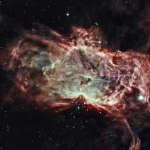 Inside the Flame Nebula
17.04.2021
The Flame Nebula is a stand out in optical images of the dusty, crowded star forming regions toward Orion's belt and the easternmost belt star Alnitak, a mere 1,400 light-years away. Alnitak is the bright star at the right edge of this infrared image from the Spitzer Space Telescope.
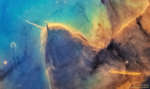 Trifid Pillars and Jets
22.12.2020
Dust pillars are like interstellar mountains. They survive because they are more dense than their surroundings, but they are being slowly eroded away by a hostile environment. Visible in the featured picture...
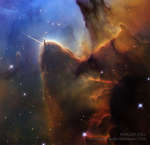 APOD: 2026 May 3 Б Trifid Pillars and Jets
3.05.2026
Dust pillars are like interstellar mountains. They survive because they are more dense than their surroundings, but they are slowly being eroded away by a hostile environment. Visible in the featured picture...
|
January February March April May June July August September |
|||||||||||||||||||||||||||||||||||||||||||||||||